

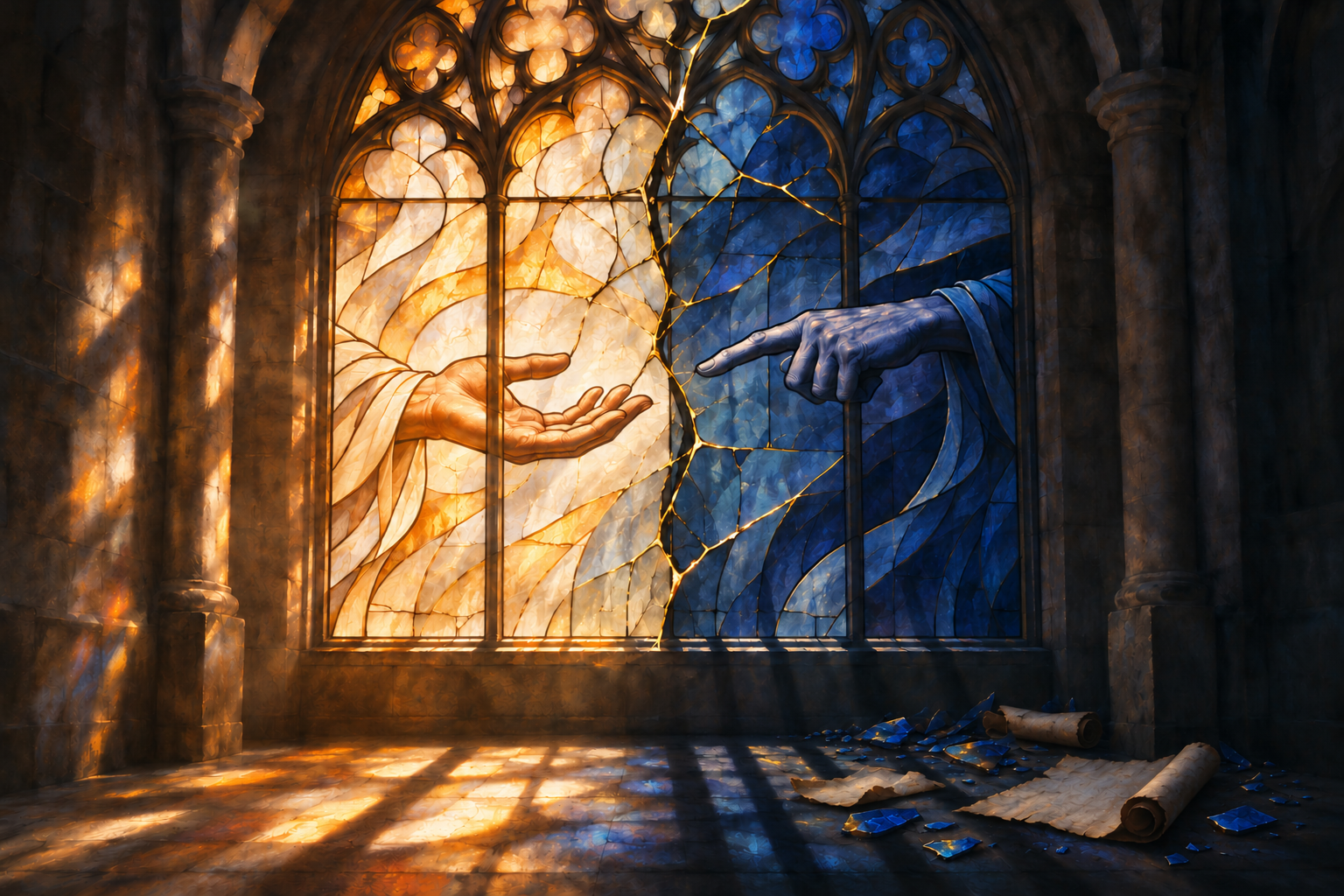
“Don’t save your soul on me.”
This was a constant refrain I heard from my professor. He directed it at the Bible Thumpers: those who would knock on your door, invite you to their church, quote a Bible verse, and question your commitment to accepting Jesus Christ as your Lord and Savior, all in an attempt to save your soul.
I do not doubt the sincerity of some. But for many, this is an act of selfishness. The salvation they are concerned about is their own. Some will express great umbrage toward you for getting in the way of achieving that salvation.
My professor’s refrain has echoed in my head ever since. His words would take on new, expanded meaning for me as I came to understand the reach of this mentality.
I lived in the Bible Belt, where you cannot throw a rock without hitting a church—and if you miss, you will probably land in another church’s parking lot. The South has a certain flavor of Christianity, one that leans more radically fundamentalist. A person can feel it in the air.
There is a particular brand of morality, a self-righteous attitude that runs deep through generations. It is a morality born in part from a strict, literal interpretation of the King James Version, the New King James Version, the Christian Standard Bible, the New International Version, or the New American Standard Bible—take your pick.
It is also born out of a deep history of old ideas, old traditions, and old sins. I have long said that the South is still seceded from the Union in mind and heart. The morality that once allowed for the enslavement of other human beings still casts a shadow and influences the mindset.
Progress is made and laws may change, but the attitudes that gave rise to them do not simply disappear. They are passed down through families, reinforced from pulpits, and woven into a culture’s understanding of right and wrong. The language changes; the desire to preserve a familiar order remains. Certain people are still expected to know their place and stay in it, while those who benefit from their silence preach that order as moral. This brand of morality runs deep in the character of the South.
Bias, racism, and the treatment of women as second-class citizens exist throughout the world in differing degrees. There are countries where oppression dominates at atrocious levels. It is found in the United States, too, varying from region to region. The South has a particular brand with an unapologetic Christian stamp.
Religion has often provided the language in which to defend an established order. Scripture can be selected and interpreted to affirm one person’s authority over another, to demand obedience, and to portray resistance as a moral failing. When the beliefs and morality of one person are presented as the will of God, the person questioning them is no longer merely challenging an earthly authority. They are challenging a supreme authority: their God.
In this way, a particular interpretation becomes the measure of righteousness, and the suffering caused by imposing that morality upon others is dismissed as the price of preserving their own morality—their souls.
It takes on the character of a contest: the one who collects the most souls gets their ticket on the train to Heaven punched and maybe reserves a first-class seat. There is more selfishness in the act than selfless concern for another’s soul. The willingness to impose their brand of morality is justified by their righteous intentions. This is the essence of my professor’s refrain.
The doctrine used to uphold this morality rests on a book written in a historical world many of its most ardent defenders have little understanding of. Patriarchy is written into the DNA of the Bible. Much of Christian orthodoxy has been built on a millennia-old tradition, carried through the centuries and reflected in present-day misogyny.
There is a condition I call Southern Belle Syndrome. Tammy Wynette co-wrote its anthem, Stand by Your Man, whatever her own intent may have been. The phrase would infuriate feminists and haunt women trying to escape abusive marriages.
Christian women are expected to marry and never divorce. Women who are not Christian may still find themselves judged by those same morally superior expectations. I would discover for myself that, in the eyes of some, it does not matter what the husband does: you are expected to stand by your man, even if it kills you.
There is another saying in the South: being put out to pasture. When there is a familiar saying for a deed, one has to consider how deeply the practice has become embedded in the culture. I know of no particular anthem for the moment when a husband decides his wife is too old and replaces her with someone much younger. In the versions I witnessed, the age for being put out to pasture was around forty. The syndrome has left a long line of Southern martyrs.
The rules are unevenly applied. A woman may be expected to endure, forgive, and preserve the marriage, while a man’s conduct is excused or overlooked. When she refuses to accept her assigned place, her resistance can become the offense. Those expectations do not remain confined to the home; they are carried into churches, courtrooms, and legislatures by people convinced that the order they are defending is righteous.
This doctrine becomes systematic oppression when that mission enters public policy. When the “righteous” take hold of the levers of government and use political power to change laws and shift policy agendas in an effort to “save the soul” of the nation, the nation begins to take on the shape of a theocracy rather than a democracy.
This mentality finds a larger and more dangerous expression when religious certainty becomes bound to national identity and political power. White Christian Nationalism claims the nation for a particular vision of Christianity, raising the question of who belongs and whose rights will be protected. Christian Zionism carries another set of religious convictions into foreign policy, where interpretations of prophecy can shape how people view Israel, Palestine, and the lives caught between them.
In both, beliefs held as sacred can acquire consequences far beyond the people who hold them. When the certainty of a promised future outweighs concern for those suffering in the present, we must ask what has become of the compassion at the heart of the faith. The history and consequences of these movements deserve a fuller discussion—one I intend to return to.
The impulse to impose one’s morality does not begin and end at the doors of a church. It reaches into what the rest of us can read, what we can watch, and what ideas we are permitted to encounter.
After I moved to Alabama in 1988, I wanted to see Martin Scorsese’s The Last Temptation of Christ. The film had provoked outrage among Christians who objected to its portrayal of Jesus. I could not find it in theaters where I lived, and when it was released on video, finding a copy to rent became its own undertaking.
I finally learned of a video store that had one copy. It was kept in the back with the XXX movies. I had to put my name on a list and wait for the store to call when it was my turn to rent it. Eventually, I got to see the film—but only after navigating the obstacles placed between me and a story someone else had decided was offensive.
What gives anyone the right to decide what I may watch or read because it offends their religious beliefs? They are free to decline a film or close a book. Why must the rest of us be denied the opportunity to make that decision for ourselves?
Years later, Philip Pullman’s His Dark Materials drew fierce religious opposition, including a boycott of the 2007 film adaptation of The Golden Compass. Pullman is an atheist, and critics warned that his stories would lead children away from religion, often reducing the trilogy to the claim that it was about killing God. His books have also been challenged and removed from some schools and libraries.
New Line did not go on to complete the planned film trilogy. While we cannot know how much the religious backlash affected the film’s U.S. box office—or whether a stronger showing would have changed the studio’s decision—we cannot dismiss the possibility that the campaign helped deprive audiences of the rest of the story.
The effort to control stories continues in the removal of books from schools and libraries, including books dealing with race, sexuality, gender identity, and the experiences of LGBTQ people. The stated purpose is often protection. But when the protection sought requires limiting access to ideas and experiences that make some people uncomfortable, we should ask whose beliefs are being protected—and at whose expense.
The reach of this morality does not stop with the stories we are allowed to encounter. It extends into our most intimate lives.
I had experienced firsthand what happens when a Southern judge brings his own moral code into the courtroom. According to his set of values, I had not behaved myself. I had been a model. My sole custody was ripped away, even as my former husband’s felony conduct, drug use, and domestic violence were set against a judgment of my character. Somehow, the woman who had lived through the abuse was the one whose morality was called into question. I provide the highlights in my essay Southern Fried Christina: Out of the Frying Pan, Into the Fire, Still Defiantly Me.
Around that same time, Alabama legislators were up to their own shenanigans. In 1998, they amended the state’s obscenity law to prohibit the commercial distribution of devices designed or marketed primarily for the stimulation of human genital organs. Private possession and use were not prohibited, and certain medical and other exceptions applied. But the state had made the commercial sale of these devices a crime.
Among those who challenged the law were women who used such devices to address difficulties achieving orgasm. One had begun using them on the advice of her physician; another used them with her husband after experiencing difficulties following a partial hysterectomy.
In 2007, a federal appeals court upheld the restriction, finding that the state’s interest in preserving public morality provided a sufficient basis for the law. Apparently, Alabama’s concern for morality extended all the way into the intimate lives of consenting adults—and made it harder to obtain devices that could contribute to their sexual health and pleasure. Heaven forbid actually enjoying sex.
If the state could reach this far in the name of morality, consider what happens when it claims authority over a woman’s most consequential decisions about her own body.
I cannot think of a clearer example of moral coercion than the fight over the right to choose.
For nearly fifty years, Roe v. Wade provided federal constitutional protection for the right to obtain an abortion, although that right was narrowed over time. In 2022, the Supreme Court overturned Roe and Planned Parenthood v. Casey in Dobbs v. Jackson Women’s Health Organization, holding that the Constitution does not confer a right to abortion. The decision allowed states to impose restrictions and bans that had previously been blocked.
In the name of protecting life, lawmakers have asserted authority over the bodies, health, and futures of women they will never know. In states with bans and restrictions, a woman’s circumstances, her health, her family, her faith, and her own conscience may be forced to yield to the judgment of legislators and their brand of morality—legislators who have decided it is their duty to make an extraordinarily personal decision for her.
People may arrive at their opposition to abortion through different moral and religious convictions. They are free to live by those convictions. The question is whether their convictions should be imposed by law on everyone else, including those whose faith or conscience leads them to a different conclusion.
This brings us to a principle that should be familiar to anyone who values freedom of religion: the separation of church and state.
The First Amendment protects the free exercise of religion and prohibits the establishment of a state religion by government. It protects the freedom to believe and practice, as well as the freedom of those who do not share a particular faith to live without being compelled to follow it. A government that favors one religious interpretation places the conscience of every other citizen beneath it.
Yet religious freedom is increasingly invoked as though it belongs principally to those seeking to impose their beliefs, while the freedom of everyone else becomes an obstacle to be overcome.
The same tension appears in arguments over the rights of LGBTQ people. In 303 Creative LLC v. Elenis, the Supreme Court held that Colorado could not require a website designer to create expressive wedding websites celebrating same-sex marriages when doing so would conflict with her beliefs. The Court framed the question as one of compelled speech; the dissent warned about the consequences for equal access to businesses open to the public.
That conflict raises a question our society cannot avoid: how do we protect freedom of expression and conscience while also protecting people from being excluded or treated as lesser because of who they are? The answer deserves more than an appeal to the religious certainty of one side. The people affected are not abstractions in a legal argument. They are our neighbors, our family members, and our fellow citizens.
Freedom of speech and expression belongs to them, too. It belongs to the person whose faith is different, the person who has no religious faith, the woman who refuses to submit, and the person who tells a truth that others would rather not hear.
When a community demands silence to protect its own comfort or reputation, it does not erase the harm that has been done. It protects the conditions that allow that harm to continue. And when the person who speaks is treated as the problem, the punishment serves as a warning to anyone else who might find the courage to speak.
Mississippi, a state with a long and painful history of racial oppression, has elected Scott Colom to the United States Senate. He will be the first Black senator chosen by the people of Mississippi. The state’s previous Black senators, Hiram Revels and Blanche K. Bruce, were elected by the legislature during Reconstruction.
This is the same state whose legislature rejected the Thirteenth Amendment in 1865 and did not vote to ratify it until 1995—nearly 130 years later. The amendment had long since become part of the Constitution, but Mississippi’s symbolic ratification was not even filed with the federal government until 2013.
History also reminds us that progress can provoke backlash. I believe part of what brought us Donald Trump was a reaction to the election of Barack Obama, the nation’s first Black president. For some, the progress his presidency represented was a threat to a familiar order.
Scott Colom decidedly did not stay in the place that an older order would have assigned him. The people of Mississippi chose him to represent them. That is a moment worth recognizing—and a reminder that change can come, even where the weight of history is heavy.
The question now is whether we can meet progress with the courage to carry it forward. I hope Mississippi’s choice marks another step toward a future in which no one is told to know their place—and that this time, the backlash will not drag the state backward.
There is no virtue in safeguarding your righteousness at the expense of another person’s freedom. A morality that demands obedience while overlooking suffering has lost its way. A faith that requires the silencing of another human being has forgotten the dignity of the life before it.
We are capable of something greater: a society where freedom of conscience belongs to everyone, where truth is met with courage rather than punishment, and where the worth of a human life is not measured by its willingness to submit. If your salvation requires me to surrender my voice, my body, or my dignity, then I have only this to say:
Don’t save your soul on me.