Orange Elephant in the Room
There are moments in history when nations reveal who they truly are—not through their ideals, their constitutions, their flags, or their rhetoric, but through the choices they make when confronted with moral clarity.
The election of Donald Trump was one of those moments.
The reelection of Donald Trump after everything that occurred during his first term was something even darker.
History will not judge this era kindly.
For generations Americans have mythologized themselves as defenders of democracy, champions of liberty, and moral leaders of the modern world. Yet nations are not judged by mythology. They are judged by behavior. By what they tolerate. By what they normalize. By the harm they knowingly permit when comfort, tribalism, fear, greed, resentment, or power become more important than conscience.
Trump did not emerge from nowhere. He is not an anomaly detached from American society. He is the culmination of decades of cultural decay, intellectual erosion, media manipulation, institutional cowardice, celebrity worship, hyper-consumerism, grievance politics, and the slow collapse of civic morality.
He is the symptom.
But symptoms still kill.
There is a dangerous temptation among Americans to speak of Trump as though he were merely “controversial,” unconventional, or politically disruptive. This framing minimizes the severity of what has occurred. Trump represents something far more corrosive than partisan conflict. He embodies the normalization of dishonesty, cruelty, corruption, narcissism, authoritarianism, anti-intellectualism, and civic nihilism as acceptable traits in leadership.
The true moral failure was not that such a man existed.
The true moral failure was that tens of millions of Americans looked directly at him—after the lies, the corruption, the open contempt for democratic institutions, the encouragement of political violence, the constant dehumanization of others, the assault on truth itself—and said:
“Yes. More of this.”
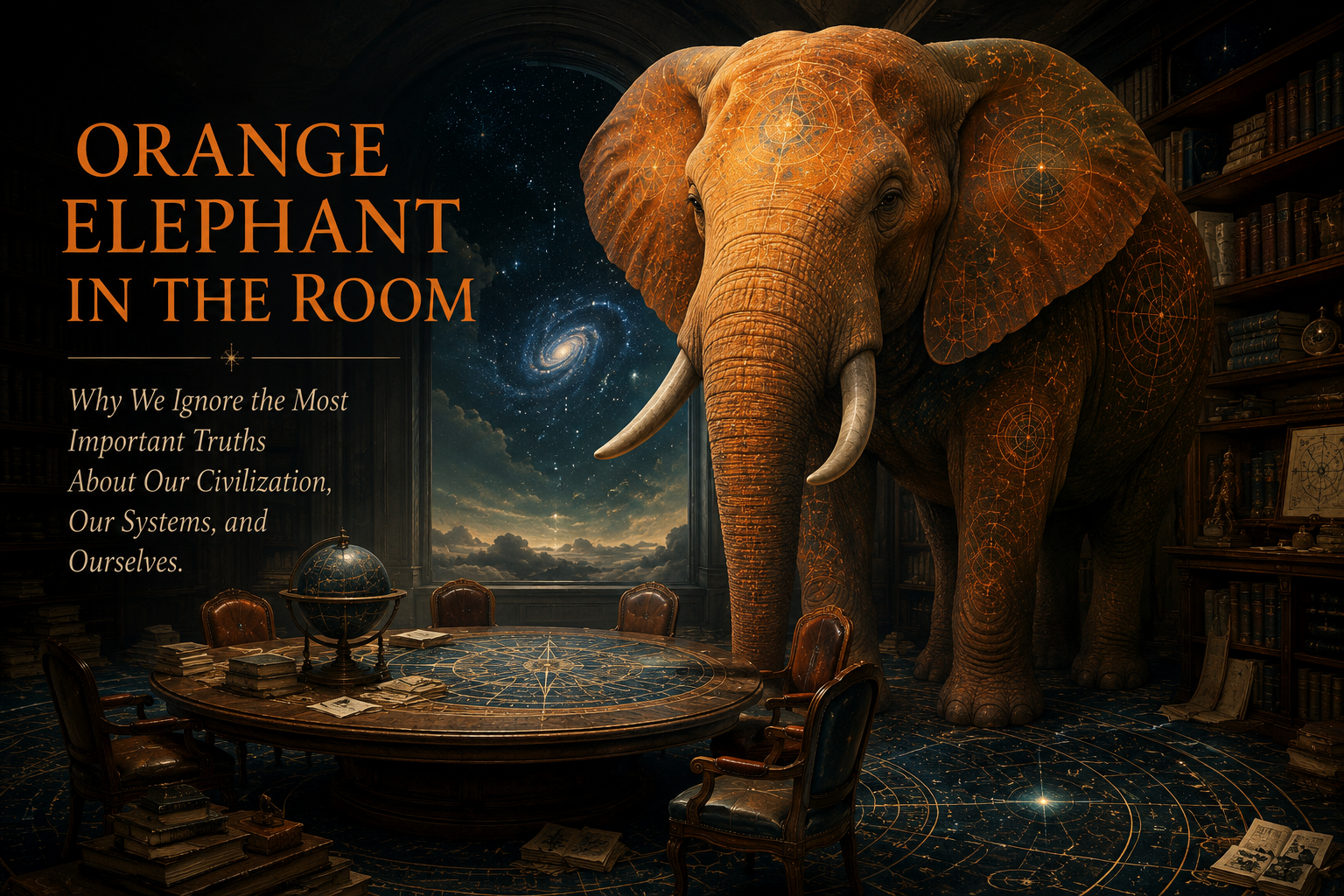
That is the Orange Elephant in the Room.
The first election exposed deep fractures within American society. The second election exposed something far worse: that the nation had learned nothing from the first.
By the time Americans chose Trump again, there could be no plausible claim of ignorance. The chaos was already visible. The corruption was already visible. The cruelty was already visible. The attacks on democratic norms were already visible. The manipulation, the disinformation, the transactional morality, the open contempt for expertise, science, journalism, law, and constitutional restraint—none of it was hidden.
It was embraced anyway.
This matters because societies become what they reward.
When dishonesty is rewarded with power, dishonesty spreads.
When cruelty is rewarded with applause, cruelty spreads.
When ignorance is reframed as authenticity, ignorance spreads.
When shamelessness becomes strength, moral gravity collapses.
Trump did not invent America’s sickness. He revealed how advanced it already was.
A healthy civilization does not elevate a man whose entire political identity is rooted in division, grievance, ego, vengeance, and spectacle. A healthy civilization does not repeatedly reward pathological behavior because it is entertaining. A healthy civilization does not treat corruption as charisma or authoritarian impulses as leadership.
But modern America increasingly confuses spectacle for substance.
The rise of Trump coincided with the rise of a culture that transformed politics into entertainment, outrage into currency, and attention into power. America created a media ecosystem optimized not for truth, wisdom, or civic health, but for emotional stimulation and tribal engagement. The result was a population increasingly unable—or unwilling—to distinguish performance from competence, propaganda from reality, confidence from wisdom, or dominance from strength.
Trump mastered this environment because he was created by it.
For years Americans consumed reality television, outrage media, algorithmic tribalism, celebrity culture, conspiratorial thinking, and performative cruelty as entertainment. The boundaries between governance and spectacle dissolved. Politics became less about ethical responsibility and more about identity performance and emotional gratification.
The Apprentice did not merely entertain America.
It trained America.
America’s internal decline destabilizes the entire global order because the modern world has been built around American economic, military, technological, financial, and cultural power. The United States is not merely another nation operating in isolation. As the world’s dominant superpower and largest economic force, America possesses immense influence over the trajectory of human civilization itself.
With that influence comes moral responsibility.
A nation wielding this level of power does not have the luxury of behaving recklessly without consequence. When America descends into disinformation, authoritarianism, corruption, anti-scientific thinking, institutional paralysis, environmental negligence, and civic fragmentation, the damage radiates far beyond its own borders. Markets destabilize. Democracies weaken. Extremist movements gain confidence. Climate action stalls. International trust erodes. The global ecosystem—political, economic, technological, and environmental—becomes more fragile.
In an interconnected world, great power divorced from moral responsibility becomes a planetary threat.
The tragedy is that America once aspired, however imperfectly, to be a stabilizing democratic force within the international order. Increasingly, however, it exports division, spectacle, disinformation, hyper-consumerism, and political dysfunction instead. The consequences are not merely national.
They are civilizational.
Trumpism normalized a politics in which objective reality became subordinate to tribal loyalty. Facts became optional. Expertise became suspicious. Journalists became enemies. Scientists became conspirators. Judges became illegitimate whenever rulings proved inconvenient. Elections themselves became valid only if one side won.
No civilization can survive indefinitely once truth becomes fully politicized.
This is not merely a political crisis.
It is a civilizational crisis.
The deeper danger is not Trump as an individual. The deeper danger is what his rise reveals about human beings when fear, resentment, tribal identity, economic anxiety, status insecurity, and mass psychological manipulation overwhelm moral reasoning and democratic responsibility.
Human beings like to imagine themselves rational creatures guided by principle and ethics. History repeatedly demonstrates otherwise. Under the right conditions, populations will normalize almost anything if it is emotionally satisfying enough, tribal enough, profitable enough, or frightening enough.
The tragedy is that humanity stands at the precise moment in history when wisdom is most necessary.
We face ecological collapse, democratic backsliding, technological disruption, mass disinformation, artificial intelligence, economic instability, biospheric destruction, and existential global risks requiring unprecedented levels of cooperation, intelligence, humility, and long-term thinking.
Yet large portions of society retreat instead into grievance, tribal mythology, scapegoating, authoritarian fantasies, and anti-intellectualism.
This is not evolution.
It is devolution disguised as progress.
Trump is not the disease.
Trump is the warning.
He is what emerges when a civilization loses the ability to distinguish freedom from narcissism, strength from domination, patriotism from idolatry, information from propaganda, and morality from tribal loyalty.
Trump may eventually disappear from the political stage, but civilizations do not recover simply by removing a symptom while continuing to nourish the disease that produced it.
Until America confronts the deeper values and pathologies driving its unraveling, the decline will continue—regardless of who occupies the White House. The crisis is no longer simply political.
It is civilizational.
America did not merely elect Trump.
America revealed itself through Trump.
And history may ultimately remember this era not as the moment democracy was attacked from outside forces alone, but as the moment millions willingly surrendered their civic and moral responsibility from within.
Because civilizations rarely collapse all at once.
More often, they decay slowly from within, convincing themselves they are still exceptional even as the foundations rot beneath them.
History is filled with societies that believed they were too advanced to fail.
History is filled with civilizations that mistook power for wisdom.
History is filled with peoples who normalized corruption, cruelty, spectacle, division, and moral cowardice until the system finally consumed itself.
The question is whether humanity—and America in particular—still possesses the self-awareness necessary to change course before the unraveling accelerates beyond repair.
That remains unwritten.
For now.