

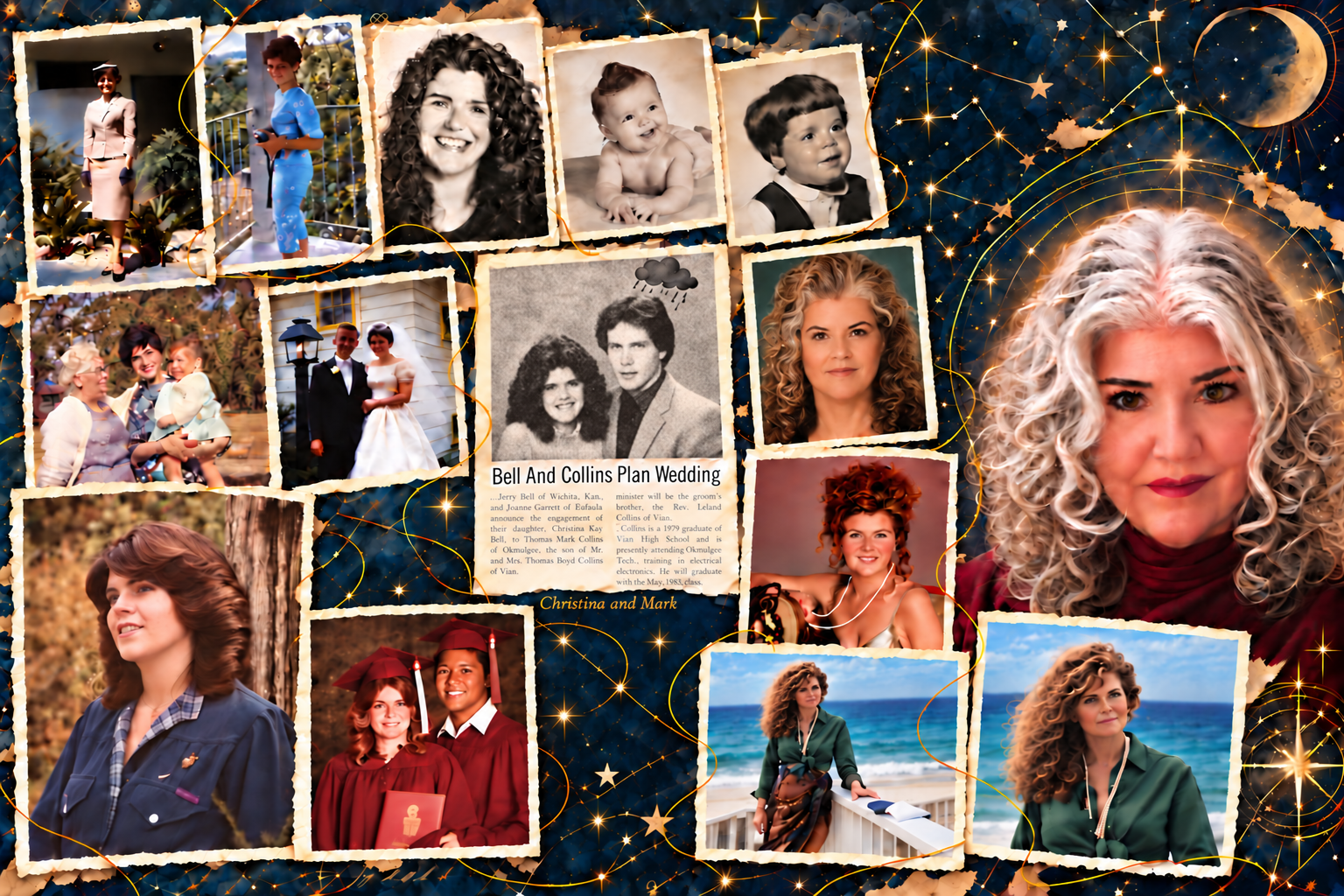
*Image of High School Graduation, pictured with classmate
At sixty-three, I am a mother, a grandmother, and the thinker behind The Cosmic Tapestry, where I explore the nature of reality, consciousness, geopolitics, physics, and how humanity evolves. I live in the Seattle area, far from the South where my story began. I remain constantly curious about the nature of things, and I have been known to hold a few opinions. I also have a reputation for not being afraid to share them.
The path to this destination was something I never would have imagined. It would give me an intimate understanding of patterns of abuse and discrimination, of how much power a single judge can wield over a life, and of the good ol’ boys mentality woven into a system that promises justice while allowing people to fall through its cracks. Along the way came about a dozen marriage proposals—apparently, I had not lost my appeal—along with occasions to discover my own force, resilience, and enduring inability to show injustice the respect it seems to expect.
For as long as I can remember, I have been drawn to the metaphysical, the mystical, and the nature of reality. My interests have wandered through history, geopolitics, economics, psychology, technology, and science fiction—anything that piques my curiosity and gives me more to understand.
Long before I began articulating the ideas behind The Cosmic Tapestry, the threads of my own life were already woven into it: people, beliefs, expectations, and choices whose significance I could not yet understand. Some I would cherish; others I would spend years trying to untangle. Through it all ran my own stubborn thread—the part of me that kept questioning what I was supposed to accept, even when I had no idea what refusing would cost.
To trace those threads, I have to begin with the family I grew up in, where I first learned what was expected of me. I had a difficult time finding expectations that made sense to me. I still do.
I was never particularly good at knowing my place. I consider that one of my better qualities—although, for me, it turned out to be a costly one. I resisted definition in a world that demands it, along with the labels that supposedly explain who we are. I absolutely abhor labels. I have my own theories about character traits that do not seem rooted in the experiences of this life, but that is a subject for a separate essay. This one is my story—a story I hesitated to tell for many years.
We cannot measure the full impact of who our parents are and how we were raised until we have traveled far beyond the children we once were. We may become people shaped by a determination not to be like our parents, only to discover how deeply the people that raised us have shaped us all along.
Years later, when I was back in Huntsville and my youngest daughter, Jasper, was about three months old, my father came to visit us. My mother visited later. A dear friend of mine, a psychologist, met each of them.
During her visit, my mother insisted that I put my infant in childcare and work for someone other than my dad. I tried to explain that I had been unable to find childcare that would accept her at three months. While I was holding my baby, my mother physically attacked me, hitting her granddaughter in the process. I left my own home with my daughter. My friend picked us up. The following day, I put my mother in a taxi to the airport.
Afterward, still reeling, I sat there across from my friend. She shook her head and made an observation I have never forgotten. I cannot recall her exact words, but it went something like this: “I’ve been doing this work for years. I’ve seen all kinds of things. But I’ve never seen anything like your family dynamics! I’ll never understand how those two got together, let alone got together and had you!”
There I was listening to my friend put into words a question I had long carried and would continue to return to—about my own family, and more broadly about how people come together, what they expect from one another, and how those expectations shape the lives of the children they bring into the world.
I believe my mother saw in my father someone of a certain stature: a highly educated engineer from a good Catholic family. My mother, raised Methodist, converted to Catholicism. Neither the conversion nor the marriage would last.
When I was six months old, my parents moved to Oklahoma after my father accepted an engineering job in Tulsa. They never seemed particularly close. They divorced when I was nine. My father certainly had his flaws; he suffered from constant headaches and had apparently experienced a nervous breakdown. This was not what my mother had envisioned in a husband. Their marriage was unlikely to have worked, but I always felt that she abandoned him when he most needed the support of those who loved him.
My relationship with my father would have its own history. Among the things we shared was an interest in technology. We built my first computer together in the early nineties. I am not a computer geek, but I can handle myself. If I did not know something of computers and technology he would return and haunt my ass. 👻
I have always described my mother as “not the most nurturing sort.” I have long suspected narcissistic personality disorder. Her serious mental health issues surfaced during my late teens. Her treatment of me would have a profound impact on my life, particularly after she remarried when I was eleven.
As I saw it, my mother’s approach to marriage had more to do with financial security than love. My stepfather was certainly capable of providing, and he had expectations about what that entitled him to demand. He was emotionally abusive toward me. Among his expectations was that I disown my father. His reasoning was that my father did not provide financially, while he did, so my loyalty should belong to him.
I would not.
I did not fit into his world, and I made it clear that I had no desire to conform to it. I was academically inclined and already grounded in a sense of who I was. That made me the black sheep of the family.
I once asked my stepfather what his problem was. I was a good kid, a good student, never got into trouble, and was always babysitting my stepsister’s children, whom I love very much. I never received an answer. What my mother, my sister, and his children never seemed willing to acknowledge was he was an alcoholic.
Through all of this, and the epic storm still heading my way, my mother was indifferent at best. Throughout my life, she was emotionally and verbally abusive. She made it clear how much she hated my father and then constantly told me that I was just like him. She never seemed to consider for a moment what message she was sending me.
When I later told her about domestic abuse during my marriage, hoping she would become the mother I needed, she would ask what I had done to deserve it—or bring up a load of clean laundry she thought I had taken too long to fold.
My mother and I have had a lifetime to get acquainted. I think it is fair to say that neither of us got quite the daughter or mother she had in mind. But as my teenage self told my stepfather, “I do not want to be who I would have to be to get along with you.” The same would hold true for my mother, my sister, and others whose paths crossed mine.
I accepted long ago who she is and how little I can change about our relationship. I can also say what it has cost me. Acceptance, after all, does not require a glowing review.
By the time I was ready to leave home, the shy young girl had left the building for good. I had enough experience to want out of the frying pan, and enough innocence to believe I was heading somewhere cooler. I entered college with all kinds of ideas in mind. Marriage was not one of them.
Then I met the best-looking guy on that campus, or likely any other. Mark.
There were signs of what was to come. Over the first year and a half, I got glimpses of his temper, slaps, cheating with women and men, drugs, and stealing. His parents had long enabled him with money and picked him up after he was caught shoplifting boots at sixteen. They consistently told him he needed to behave better.
I broke it off more than once. He would beg me not to. I broke it off when I discovered that his trips back to Lake Tenkiller, where he had grown up, had another purpose: he and a couple of buddies were breaking into lake homes to steal— including his own brother’s. His family knew, but apparently he just needed to “behave better.”
I broke it off after he hit me for the first time. Promises and begging persuaded me to return. I may have been wise for my age, but I had not yet learned about cycles of abuse or how to recognize the pattern.
Besides, he was good-looking. 🙄
He could straighten up and behave well for long periods. One such stretch lasted more than a year, long enough to convince me to marry him—or, more accurately, to go along with his expectation that I would.
Years later, after our divorce, I was driving home from visiting friends in Huntsville. The girls were with their father, and I was thinking about things, as I do. I cannot say why the realization arrived at that particular moment, but suddenly I thought, “Shit! I got married because I had sex!”
My mother had pounded into my head that sex was for marriage. Funny how she would later adjust those values when it suited her. Mark was my first, and I was not with anyone else until a year and a half after our divorce. Did I love him? I thought I did. But even someone as independently minded as I was could carry expectations she had not yet stopped to examine.
At the time, I did not know I was jumping from the frying pan into the fire.
By the time the violence, cheating, stealing, and drug use began again, I had my first child. Mark was getting a job with Boeing in Wichita, courtesy of my father, who was a Boeing engineer at the time. That job would eventually be held over my head as a reason to excuse his behavior.
The following eleven years brought variations on the same cycle: straighten up, start again. All the while, I tried to persuade him to seek help.
We left Wichita because we wanted to be in Tulsa. He lost a job for stealing equipment. The abuse continued, and forced sex became part of it. Oklahoma’s rape law at the time excluded spouses from its definition of rape. Marriage turned me into a second class citizen and provided him rights over me and my body.
I thought about leaving. I ended up pregnant again. Whenever I tried to leave, his family, my mother, and my stepfather pushed me back instead of supporting me.
There I was, pregnant with my second daughter, and he had lost his job. He had kept in touch with his Boeing manager. I did not know that this connection would become the catalyst for turning the fire under my ass into a freaking bonfire.
In January 1988, Mark returned to Boeing, this time in the Huntsville area of Alabama. I stayed in Tulsa until after our second daughter was born. He returned for her birth, and in May he moved all of us to Alabama. Our mobile home had traveled from Wichita to Tulsa and now to Limestone County, where we had bought an acre-and-a-half lot with help from his parents, of course.
Through everything, I was never a shrinking violet. One night, our infant daughter developed a life-threatening fever. When I tried to wake him to call the doctor, he swung at me and cursed me out. I managed our daughter’s care while getting the doctor on the phone, working to bring her fever down.
Once the fever had come down and she was asleep again, I returned to the bedroom, grabbed my six-foot-one husband by the feet, and pulled him out of bed onto the floor. I told him that when his daughter had a life-threatening fever, he had better get his ass out of bed. I may have thrown in a couple of expletives. 😇
I warned him again and again that one day the straw would break the camel’s back. Over the next few years, the abuse grew more intense. He threatened my life. He threw a brick through a window at me, narrowly missing our oldest daughter. He broke glasses on the table while we were eating. He would tell me repeatedly that I should be glad that he did not keep a gun in the house. We were constantly on edge.
Then came the arrest.
One Tuesday evening, I was home with my two daughters while he was out running “errands.” The local news was on, and a CrimeStoppers report aired. Law enforcement was looking for a man who had been stealing merchandise from Walmart, Kmart, and area department stores, then returning it without a receipt for cash. The description fit my husband to a tee.
I stopped in my tracks, hoping it was not him.
Late the following Friday, I received a call telling me to bring my daughters to a bail bondsman’s office to bail him out. I had to pull the girls out of bed. The bondsman would collect him so I would not have to take two young children to the jail. He had been arrested on a felony charge. What he was actually caught and charged with represented only a fraction of what he had been doing. In the end, he got little more than a slap on the wrist.
There is not much I regret in life. I regret bailing him out that night.
He was upset with me because I was upset. That was the straw. I spent the next two years fiercely distancing myself from him. I had him out of the house in October 1993. By the following December, the divorce was final. I had sole custody of both girls, and he had generous visitation.
My position was always that what happened between their parents should stay between their parents. I wanted my girls to have the best relationship possible with their father.
For a while, I thought I could breathe. He was more cordial than I had expected. Eventually, I realized that he was giving me what I wanted because he believed I would agree to get back together.
People often say the opposite of love is hate. To me, both involve emotional attachment. What I felt by then was indifference. He would come to realize that, and that would be unacceptable to him.
I earned two degrees, in Religion and Philosophy, with a dash of physics along the way. I graduated with a 3.98 grade point average from a university in the same town as the courthouse where I would spend so much time fighting for my children. I wanted to pursue a doctorate at Emory. With my grades, I believed I had a good chance of a scholarship, and I would later receive an invitation to meet with an advisor at the Candler School of Theology.
In the spring of 1996, I moved to the Atlanta area for better schools and more opportunities. The girls stayed briefly with their father while I moved, set up an apartment, and returned to modeling. I then brought them home, was enrolling the girls in school, and continued building our lives together. They were thirteen and eight. Until then, we had been inseparable.
For a moment, I thought the worst experiences of my life were behind me. What I did not know was that, back in Alabama, a very different future was being arranged for us.
Mark remarried in June. He and his new wife apparently decided that our divorce decree, my custody, and the bond I shared with my daughters were inconveniences to be disposed of. Mark wanted his vengeance. The new wife wanted something more; it would become obvious she considered me a threat to her marriage. With the assistance of an attorney of a certain reptilian character in Limestone County, they began proceedings without my knowledge.
In August, they appeared unexpectedly at my apartment, saying they had spoken to the girls and were there to collect them for visitation. His visitation rights included time before the school year began. My youngest vehemently did not want to go. They suggested ice cream and promised to bring the girls back if she still did not want to go with them afterward. He later called to assure me everything was fine.
We arranged to meet the following weekend at the old property in Alabama, which I still owned, so he could return them.
On Saturday, August 10, 1996, I was there at the agreed time.
He did not show.
Instead, I was served with papers ordering me to appear at an emergency custody hearing early Monday morning. I spent the weekend not knowing what he had done with my girls.
On Monday, August 12, I found an attorney with less than two hours to prepare and walked into a Limestone County courtroom expecting that my existing custody decree, my daughters’ welfare, and the basic requirements of due process would mean something.
How extraordinarily naive of me.
I discovered that hearings had already taken place without my knowledge. Legal notices had been directed to the old Alabama address where Mark and his attorney knew I no longer lived and would not receive them. I had been denied any meaningful opportunity to prepare or defend my rights as their mother.
Then I watched a judge effectively discard my custody decree.
His stated reasons? I was working as a model, and I had previously homeschooled my oldest daughter for a period before enrolling her in school in Atlanta. During that hearing and the proceedings that followed, “model” would become “escort,” then “prostitute.”
In that courtroom, the Southern good ol’ boy idea of a woman staying in her place carried more weight than my daughters’ welfare. I had failed to stand by my man, imagined a life beyond him, and dared to claim my own sexuality. My modeling career and educational choices became evidence against my fitness as a mother. As the proceedings continued, violence in his home, stealing, and exposure to a stepmother’s drunkenness failed to provoke the same urgency. A woman’s independence, daring to claim a life of her own, was treated as the emergency.
I have since examined the legal protections that were supposed to govern what happened to us. Taking children from a custodial parent without proper notice and an opportunity to be heard required narrowly defined emergency circumstances involving danger to a child’s health or physical well-being. Those protections were already established even in Alabama.
They took my children through proceedings I had not known were happening. My rights—and my daughters’ wellbeing—were treated as expendable.
That afternoon, I had to drive back to Atlanta for my job without my girls. After a weekend of not knowing where they were, I now knew that the court had taken them from me. I had no idea what to do next.
Initially, I was reduced to seeing them every other weekend.
It would get considerably worse.
Within weeks, domestic violence erupted in their father’s new household. During one weekend visit, my oldest daughter disclosed enough that a Georgia judge, after speaking privately with her, helped me temporarily keep the girls safe. But he explained that his authority was limited and that I would ultimately have to return to the Alabama court.
So I did.
I presented the allegations of violence. Police had been called. There were genuine concerns about my daughters’ safety.
Nothing mattered.
The judge ordered them returned to their father and stripped me of virtually every avenue of contact. No visits. No telephone calls. No letters. No gifts.
The first time I ever got drunk was Thursday, August 15, three days after the judge first discarded my sole custody decree. After he cut off all contact with my daughters, I drank more than usual. That did not last, but my world had shattered into pieces, and it felt like everything was spinning out of control.
Imagine being the mother who had raised two daughters, inseparable from them throughout their childhood, and suddenly being legally forbidden to even ask them how they were doing or to tell them you loved them.
Yet I continued fighting.
When their school contacted social services because their stepmother was reportedly collecting them while intoxicated, I went back to court. When there were further incidents of domestic violence, I went back to court.
Again and again and again.
Over the course of those proceedings, I requested a guardian ad litem three times: a court-appointed advocate whose responsibility would be to independently represent only my daughters’ best interests.
Three times, the judge denied my request.
If their welfare was the justification for all of this, why refuse them an independent advocate?
Over the years, I went through ten attorneys. Too many seemed more concerned with navigating the local legal establishment than challenging it. One exception was a former judge from Huntsville who genuinely cared, recognized the injustice, and made real attempts to help me. Eventually, he told me he feared that his involvement might be doing more harm than good in front of that particular judge.
Why? He was a Black man.
Even an attorney who had served on the bench had to consider whether his presence could make things worse for the woman he was trying to represent. The good ol’ boy network was alive and well, and I was discovering just how thoroughly it could close ranks. Others were happy to take my money and then throw me under the bus. Eventually, I handled the proceedings pro se—representing myself.
Just how much destruction can one person inflict upon another when the machinery of the judicial system becomes an instrument of personal vengeance? As it turns out, quite a lot. When those entrusted with administering justice participate in that destruction, the consequences can reverberate across generations.
Meanwhile, the rules governing my relationship with my own children had become almost perversely absurd.
Their stepmother would sometimes telephone me and say the girls wanted to talk. Of course I talked to them. On another occasion, she told me I could bring them Easter gifts.
For trying to maintain those fragments of motherhood, I was arrested for contempt of court.
I was hauled back to Limestone County and thrown into a hole for ten days, without knowing when I would be released. My father began calling officials, furious that his daughter’s civil rights were being violated, until a bail hearing was finally arranged.
By the time I returned to Atlanta, I had lost my job. One generally does not remain gainfully employed after disappearing into an Alabama jail without warning. A British RAF soldier who was rather madly in love with me sent money from overseas so I could pay my rent.
Romance, apparently, was proving considerably more reliable—and definitely more fun—than the American judicial system.
Mark thought the ten days in jail would break me. The next time I saw him in court he was acting particularly cocky. As we were all exiting the courtroom he made a crack about how he at least found someone to marry. I just looked at him, brow furrowed, laughed and said: “Please. If I wanted to marry an alcoholic redneck I think I could manage that one.” He was furious; his face turned a number of shades of red.
And I kept going.
There would be more upheaval, including a relationship with a man who supposedly could not father children. Naturally, I managed to prove otherwise. 🙄
When I became pregnant with my youngest daughter, he proposed marriage but made it clear he did not want the child.
That settled that.
Pregnant and struggling financially, I returned to Alabama, initially staying with a dear friend. My father later helped me establish a home of my own in Huntsville.
I continued appearing in court, even heavily pregnant, demanding the right to be part of my daughters’ lives.
On July 7, 1999, I gave birth to my youngest daughter, red hair and all. She obviously had my stubbornness from the start. Her due date was July 23, but I kept going into false labor. The last time, my hot doctor decided to keep me there. I did laps around the hospital chanting, “She is NOT going to be a Leo!” Both Mark and her father were Leos. Thankfully, she is a Cancer.
Her sisters desperately wanted to be at the hospital for her arrival.
They were not permitted.
Eventually, I regained every-other-weekend visitation, but the judge had also ordered me to pay child support.
I agreed in court. I made one payment. The reality was that I was raising an infant, trying to rebuild my life, and carrying the accumulated financial devastation of years spent fighting to remain a mother to children who had already been mine. I could not afford to keep paying. And it went against every fiber of my being to pay that man for stealing my girls, using them for vengeance, and putting me through the seven circles of hell.
I think he added circles. 🙄
Mark, meanwhile, remained employed in a position my own father had helped him obtain. I had helped preserve that employment by bailing him out when he was arrested on the felony charge, circumstances that could have ended his career. I doubt Boeing knows the extent of what he has stolen from the company. He was unable to advance there because he could not pass the necessary background check.
Even after everything, I discouraged my father from trying to get him fired because I knew the financial consequences would ultimately hurt my daughters. I have always extended more undue grace than should reasonably be expected on behalf of my girls, and now my grandchildren. That consideration was never mutual.
His agenda to ruin me and take everything he could had been clear since August 1996. Now he was pursuing enforcement of the child-support order despite knowing that I had an infant and lacked the financial resources to pay.
I was summoned back before the same judge to explain why I was not paying. He had given me no reason to expect any grace myself. I knew I would face incarceration, and I knew that Mark and wife number two would then try to gain control of my infant daughter—a child who was not even biologically his—by arguing that she should remain with her older sisters.
I was not going to give him that opportunity.
By then, a court advocate associated with a domestic violence shelter, who had accompanied me to some of my appearances, and my psychologist friend were deeply concerned about what might happen next. They gave me advice they acknowledged they were not supposed to give.
Leave Alabama.
Get the hell out of the state.
So I packed a truck, attached my car, secured my fifteen-month-old daughter in her car seat, and began driving toward Seattle—a place I had never visited, where I knew virtually no one.
I cried for hundreds of miles.
I could not even tell my girls I was leaving. I knew the news would reach them eventually, but explaining my departure beforehand would have jeopardized everything.
There is a particular kind of agony in knowing that the only way to protect one child may be to put thousands of miles between yourself and two others.
I had no grand plan, no financial safety net, and no guarantee that the Pacific Northwest would be any kinder to me than the Deep South. But I had realized too late that Atlanta did not put enough miles between me and my ex. I was not going to make that mistake again.
What I did have was a job offer from the owner of a real estate company. He told me that if I had the tenacity to get myself to Seattle, he would give me work and somewhere to stay while I got established.
Tenacity.
Well, that was one thing I had in abundance.
Mark had continued stalking me before, during, and after my time in Atlanta, adding another layer of fear and exhaustion. And because, apparently, one stalker was not sufficient, I somehow acquired two more. 🙄
Other things happened to me during those years that I am not prepared to describe publicly. Some experiences deserve conversations with the people I love before they become part of any published narrative.
But I survived them, too.
In time, my older daughters and I were able to see one another again. Their father divorced his second wife, who died not long afterward. At one point, while my youngest was still young, he actually asked whether I would consider getting back together with him.
After I stopped laughing, I reminded him of two rather significant obstacles.
“You threatened my life. You stole my girls.”
He attempted to shift the blame to his now-deceased former wife.
How convenient. Always a scapegoat, because he could never be the bad guy in his own storyline.
He was their father. Those proceedings depended on his participation, his signature on the papers. He benefited from what happened and repeatedly chose to perpetuate it.
When my daughters became old enough to leave, they came to me.
Eventually, as young adults, they returned to Alabama, where they met their husbands and established families of their own. Six of my grandchildren would become part of my extended family.
Even then, the consequences of those court proceedings continued to shadow my life. For years, returning to Alabama carried the risk of incarceration over outstanding child-support enforcement issues, particularly if Mark made certain the judge knew I was there. He refused his daughters’ requests to resolve the matter.
A legal battle that began with my daughters being taken from my custody had become a barrier between me and the grandchildren I wanted to visit.
All of this began with an emergency custody proceeding in which the stated offenses were that I worked as a model and had once homeschooled a child.
I will never fully reconcile how someone who is supposed to love you can abuse you, repeatedly cheat on you, threaten your life, steal your children, and have so little respect for their mother that he allows her to be publicly called a prostitute.
Then there is the irony. He committed all of that theft and fraud, took and sold drugs, and subjected us to domestic violence. Yet I spent more time in jail than he did. I was a good daughter, wife, and mother. I never used drugs or committed crimes. I earned my degrees, raised my children, and worked. And yes, at times as a model.
Not a prostitute. 🤬
I will admit to mouthing off to the judge. But when you are sitting on the stand, tired of being described as a $6,000-a-weekend escort while simultaneously being accused of financial instability, you might tell a judge to have the attorney make up his damn mind. I guaranteed that if I had been working as an escort, I would not have been financially unstable. 🙄
The years that followed brought more of what I call “character-building moments.” I struggled to maintain childcare, stable housing, and the flexibility I needed to be with my youngest daughter. And as she grew up, she earned every single strand of her red hair.
I did not pursue child support from her father, a decision that attracted considerable criticism. But no one else had lived my life. I believed he would create his own hell for us out of resentment at having to pay. I made that choice because no amount of money is worth the pain that can be inflicted on my child and myself.
I kept pushing forward. Eventually, the stress caught up with me. My periodic migraines became chronic daily events. Slowly, I have been coming out on the other side of that. When your health takes that kind of hit, it throws you a whole different curveball.
I do not tell this story because I want to be regarded as a victim. Nor was every decision I made perfect. What looked like bad decisions to others, particularly my mother, often meant choosing from a menu that might as well have come from a restaurant shut down by the health department. And there is more to tell, but for this effort I am attempting to give you the highlights, not a book.
My experience taught me to question the shield surrounding judicial authority. A judge’s personal moral code can shape an order with immediate consequences for someone else’s life. An appeal may offer a route to challenge it, but it comes with deadlines and costs. When you have spent everything you have on the latest hearing, the existence of an appellate court does not mean you can afford to reach it.
Judges generally have broad immunity from civil damages for acts performed in their judicial capacity. That protection does not make every decision just. We need more accessible avenues for correcting injustice and meaningful accountability for the exercise of power over other people’s lives.
I am very close to all three of my daughters. They know that I love them unconditionally. They know that I will not be judgmental. And I am grateful for the technology that allows me to talk and video chat regularly with my grandchildren.
But even now, I am left holding it. It is like everyone knows but no one validates it, validates me. And even now, if something my mother says brings back a memory and I mention it to say that I have an understanding, her response is often, “We don’t need to talk about that.” I have become very familiar with that “we,” and with how often it leaves me holding what everyone else would rather put down. I understand that these conversations can be uncomfortable. They are uncomfortable for me, too.
And when I was finally able to visit my grandchildren, there Mark is, “popping in” every day. I would discover that he did a great deal of getting a room ready for me. And I just have to stay quiet. There would be no respect for my time with my family.
I have spent years considering everyone else’s feelings about my experience, and there comes a time to make some room for my own. What happened has already shadowed enough of my life; deciding if I am ever allowed to speak about it should not occupy the rest.
I have always placed high value on knowledge, wisdom, and intellectual rigor. I set out to learn as much as I could and to understand the inner and outer workings of things. One of my mantras, which I tried to pass on to my daughters, was, “If you are going to have an opinion, make it a well-informed one.”
I anticipated that the path to wisdom would involve marriage, children, a doctorate, travel, and building a life. I never did get the white picket fence. I learned that life does not reliably distribute what people deserve, and that justice requires considerably more than assuming it will arrive.
The education I received gave me a particular understanding of how abuse works: how promises can keep hope alive, how long periods of better behavior can obscure a pattern, and how people outside a marriage can help keep someone inside it. I learned how financial consequences can narrow your choices long after a relationship has ended. I learned how easily judgments about a woman’s character can displace attention to what is being done to her.
I also came to understand how much of what we call choice depends on the options actually available. Intelligence and determination matter, but they cannot produce money you do not have or make a powerful person answer for what he has done. That understanding informs how I look at people whose lives have fallen through the cracks. I want to know what happened, what they were up against, and what choices they genuinely had before deciding what they should have done.
My own independence did not make me immune to the lessons pounded into my head about self-worth, obligation, and never being enough. Examining those lessons has been part of becoming myself. There are things I understand now that the young woman I was could not have known. I can recognize her mistakes and still respect the effort she made with what she knew at the time.
Over the years I had my share of relationships, well, probably more than my share. Looking back, I believe some of that was an attempt to ease the pain, to find connection when so much had been torn away. I danced my way through a good bit of it. In Atlanta, I was rather popular. I did try to pull as much joy in as I could through it all. I have carried the weight of what happened for decades while continuing to be curious, to love, to laugh, and to make something of my own. Those threads belong to my life, too.
I would have preferred a considerably less expensive education. But you do not endure life-altering experiences without gaining some unique perspective and insight that become a part of you. I bring this perspective, along with a lifetime of searching and putting the pieces of the puzzle together, to The Cosmic Tapestry.
Resilience is not always graceful. Actually, it seldom is. And the grace I extend does not make me a saint. Well, maybe close. 😏😇
Rising from the ashes does not always translate into having your doctorate or being what the world considers a success. Much more often than not it does not look like the phoenix. It is just you with a pile of ashes.
But still you.
That is the glorious triumph whether others acknowledge you or not.
They took my custody. They took my livelihood. They took years of ordinary motherhood that neither my daughters nor I could ever recover. They tried to take who I am, and they stole a life I could have lived.
But they never succeeded in taking me from myself.