

The Imperial Court: The Capture of the Supreme Court
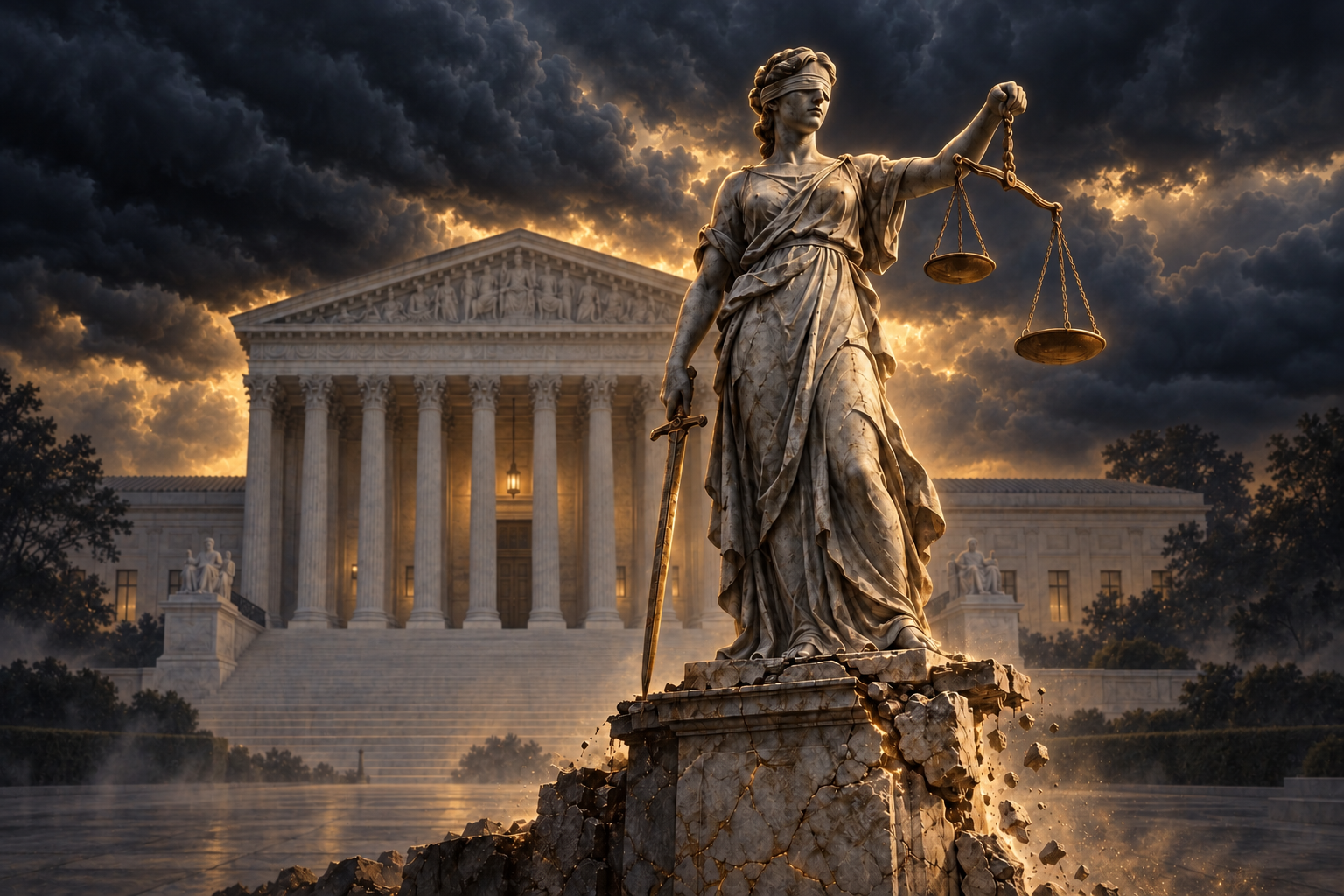
In the United States of America, our lives are governed by three branches of government: the executive, the legislative, and the judicial—each created to check the power of the others. When this system of checks and balances possesses the health and rigor it was designed to have, it provides the foundation for a vibrant democracy. But when that system is weakened, manipulated, weaponized, and ultimately broken, the freedoms we have come to take for granted are placed in jeopardy.
Our history has never been perfect. The nation was founded upon extraordinary declarations of liberty while denying that liberty to millions of people. But we were also given the tools with which to continue the work—to amend the Constitution, challenge unjust laws, expand the meaning of citizenship, and move closer to the promise contained within the words “a more perfect Union.” Across generations, Americans have used those tools to abolish slavery, establish equal protection under the law, extend the right to vote, broaden civil liberties, and create greater freedom, justice, and opportunity for those born here and those who have longed to join us in that unfinished struggle.
Progress has never traveled in a straight line. Every expansion of freedom has met resistance. There have been advances and retreats, promises fulfilled and promises betrayed. Yet the American experiment has endured because enough people continued believing that the country could become something better than it had been before.
But the tools created to protect democracy can also be used to dismantle it. Safeguards intended to prevent a majority from trampling the rights of a minority can be manipulated until they produce the opposite: a determined minority exercising power over the majority. Checks become choke points. Judicial independence becomes insulation from accountability. Constitutional restraint becomes the language through which power excuses itself. The more perfect union gets trampled by the tyranny of an ideological minority.
When public ignorance is joined by the moral certainty of groups convinced that their beliefs alone define the nation, democracy becomes vulnerable to authoritarian power. This essay argues that nowhere is that danger more evident than in the capture of the Supreme Court.
That capture did not happen overnight. It was the product of a decades-long political and legal campaign—one that treated liberal legislators, presidents, judges, and legal precedents not merely as competing interpretations of American democracy, but as enemies to be defeated. Mitch McConnell did not begin that campaign, but he became one of its most consequential strategists. To understand the Imperial Court that now sits above us, we must first begin to understand the war waged to create it.
The Supreme Court we have today is, in large measure, the product of a conservative legal movement that treated the 1987 rejection of Ronald Reagan’s nominee Robert Bork as a defining grievance. Bork was defeated 58–42 after an intensely ideological confirmation battle, with six Republicans joining fifty-two Democrats against him. Mitch McConnell, then a first-term senator, supported Bork and would repeatedly point to his rejection as the opening battle in the modern war over the federal courts. Notably at the time McConnell was only two years into his first term as a Kentucky senator. The chairman of the Judiciary Committee was Senator Joseph R. Biden. McConnell voted for confirmation of Bork; Biden voted against confirmation. They stood on opposite sides of the event McConnell would later identify as the beginning of the modern judicial wars.
For McConnell, the lesson was not simply that conservatives needed different nominees. They needed an enduring political and institutional strategy capable of controlling who reached the courts, who received a hearing, and ultimately what the Constitution would be permitted to mean. Whether understood as retaliation, political calculation, or both, that strategy would unfold across decades. By 2016, McConnell possessed both the power and the willingness to turn the Senate’s constitutional responsibility of advice and consent into a decisive instrument for determining the future composition of the Supreme Court.
The transformation of the Court would be completed through two radically different exercises of Senate power—two seats that many Americans regard as stolen—with the bitter confirmation of Brett Kavanaugh sandwiched between them.
Mitch McConnell would finally get his revenge. But he would not accomplish it alone. His strategy converged with another decades-long campaign to reshape the Supreme Court: the determination of politically organized evangelical Christians to place justices on the Court who would overturn Roe v. Wade. Donald Trump offered them an unmistakable bargain. Whatever his moral failures, whatever his conduct revealed about his character, he would give them the judges they wanted. Many accepted that bargain, separating the morality they demanded of others from the morality they were willing to overlook in the man who could deliver their desired result. This was their Faustian bargain. And Trump delivered.
On February 13, 2016, Justice Antonin Scalia died unexpectedly. Scalia was certainly no moderate. I disagreed with much of his jurisprudence and never imagined that I might one day look back on his presence on the Court with something approaching nostalgia. The fact that I occasionally do is not a reconsideration of Scalia; it is a measure of how far the Court has traveled since his death.
Scalia’s death left President Barack Obama with nearly a year remaining in his second term. Before Obama had even selected a nominee, Mitch McConnell announced that the vacancy would not be filled until after the presidential election. “The American people should have a voice in the selection of their next Supreme Court justice,” he declared—as though the American people had not already elected Barack Obama to serve a full four-year term.
On March 16, Obama nominated Merrick Garland, the widely respected chief judge of the United States Court of Appeals for the District of Columbia Circuit. McConnell’s Senate refused to give Garland so much as a hearing or a vote. His nomination remained before the Senate for 293 days before expiring with the end of the congressional term. McConnell’s pronouncement was not a constitutional requirement or an established Senate rule. It was a political principle created for the moment and enforced because McConnell possessed the power to manipulate the process.
After Donald Trump took office, he nominated Neil Gorsuch to occupy the seat that had been denied to Garland. When Democrats attempted to block the nomination, McConnell and Senate Republicans extended the nuclear option to Supreme Court nominations, lowering the threshold of votes required to end debate from sixty to a simple majority. Gorsuch was confirmed, and the first of the two seats I regard as stolen was secured.
Brett Kavanaugh followed in 2018 after the retirement of Justice Anthony Kennedy. His seat was not obtained through the same manufactured election-year rule, but his bitterly contested confirmation placed him squarely between the two acts of raw political power that would ultimately produce the Court we have today.
Then, on September 18, 2020, Justice Ruth Bader Ginsburg died—just forty-six days before the presidential election. Suddenly, allowing the American people a voice was no longer McConnell’s guiding principle. He now argued that 2020 was different because Republicans controlled both the presidency and the Senate, while government had been divided in 2016. His explanation narrowed his earlier declaration into a made up, convenient new rule created to accommodate his agenda.
Amy Coney Barrett was confirmed on October 26, just eight days before Election Day. One seat had been held open for the remainder of a Democratic president’s term because an election was nearly nine months away. Another was filled by a Republican president when an election was barely a week away. That is why I regard them as two stolen seats, with Kavanaugh sandwiched between them.
With Barrett’s confirmation, Trump had delivered what he promised, McConnell had completed the work he began decades earlier, and the conservative movement had secured a six-to-three majority on the highest court in the land.
The capture was complete.
The question now was what this Court would do with its power.
There will always be a shadow cast across the appointments of Justices Neil Gorsuch and Amy Coney Barrett. Mitch McConnell manipulated the Senate confirmation process—applying one principle to a Democratic president and its opposite to a Republican one—with little regard for the damage inflicted upon the integrity of the Supreme Court or the public’s trust in it. Neither Gorsuch nor Barrett demonstrated the institutional humility to refuse a seat obtained through those procedurally inconsistent and institutionally damaging maneuvers; their acceptance made them participants in the capture, not merely its beneficiaries. Brett Kavanaugh should not have been confirmed either. Whatever conclusion one reaches about the allegations of sexual assault against him, his own conduct during the confirmation hearings should have been disqualifying. His denunciation of the proceedings as a “calculated and orchestrated political hit,” driven partly by anger over Trump’s election and “revenge on behalf of the Clintons,” revealed the partisan grievance and lack of judicial temperament he would carry onto the Court. Mitch McConnell did not merely confirm three conservative justices. He helped construct one of the most extreme conservative courts in modern history. It is hardly surprising that public trust has collapsed along with the institutional norms he sacrificed to create it.
The six conservative justices insist they are merely following the Constitution. Yet their decisions suggest otherwise: they are imposing their own moral code in the courtroom while cloaking that power in the language of originalism, religious liberty, history and tradition, and judicial restraint.
Nowhere is this clearer than in Dobbs v. Jackson Women’s Health Organization. By asking whether reproductive autonomy was “deeply rooted” in the nation’s history and traditions, the majority tied modern women to a legal, antiquated order shaped when women could not vote, hold office, or help write the laws governing their lives. Roe v. Wade recognized constitutional protection for a woman’s reproductive autonomy in 1973. Congress would not prohibit creditors from discriminating against women on the basis of sex or marital status—and requiring a male co-signer—until the following year. The Court did more than return abortion policy to the states. It withdrew a constitutional liberty on which generations had relied and restored the government’s power to compel women to continue pregnancies.
The same code appears in Kennedy v. Bremerton School District, where the majority treated a public-school football coach’s highly visible midfield prayers as private religious expression, despite students joining him and the pressure on athletes seeking his approval. In 303 Creative v. Elenis, the Court held that Colorado could not compel a website designer to create expressive wedding websites conveying a message she opposed, even under the state’s public-accommodations law. In Mahmoud v. Taylor, it elevated religious objections to LGBTQ-inclusive books in public schools. And in United States v. Skrmetti, it gave states broad authority to prohibit gender-affirming care for transgender minors. A person may disagree with such treatment and still recognize that the deeper question is one of autonomy: whether an individualized medical decision should be dictated categorically by the state or made through a careful, well-informed process involving the young person, their parents, and qualified physicians. Though these cases involve different doctrines, they point in the same direction: conservative religious objections receive heightened protection, while the autonomy and equal participation of those who reject them become negotiable.
Other decisions reveal a broader effort to redistribute institutional power. Loper Bright Enterprises v. Raimondo is too important to omit. By overturning Chevron deference—a forty-year-old framework under which courts generally deferred to reasonable agency interpretations of ambiguous statutes—the Court shifted substantial interpretive authority from the expertise within federal agencies to federal judges. The decision did not merely reject one administrative-law doctrine. It weakened the government’s capacity to rely on specialized expertise when implementing laws enacted by Congress and invited courts to substitute their own judgments, lacking expertise, for those of agencies with relevant technical knowledge. The same redistribution of power appears in Louisiana v. Callais, where the Court invalidated Louisiana’s second majority-Black congressional district and substantially increased the burden on plaintiffs bringing vote-dilution claims under Section 2 of the Voting Rights Act. And in Trump v. United States, which granted presidents broad immunity for official acts despite no explicit constitutional basis for it. The Court is expanding executive power when it chooses, limiting Congress and federal agencies, weakening voters, and reserving more authority for itself.
For a majority that professes judicial restraint, the Court has shown little respect for stare decisis, the principle that courts should generally follow precedent. That principle is not absolute. Had it been, Brown v. Board of Education could not have repudiated Plessy v. Ferguson. But Brown overturned a decision that denied equal citizenship and betrayed the Fourteenth Amendment’s promise. In Dobbs, the conservative majority’s treatment of stare decisis demonstrated that constitutional protections recognized by earlier Courts can disappear when the Court’s membership—and its application of precedent—changes.
The Supreme Court’s history has never been straight or spotless. It has protected slavery, sanctioned segregation, permitted forced sterilization, and approved the incarceration of Japanese Americans. Yet many of its greatest modern decisions moved the country—however imperfectly—toward greater freedom, equality, and inclusion.
This Court is moving in the opposite direction. It is narrowing liberty rather than expanding it and withdrawing rights rather than extending them. It follows precedent when precedent serves its ideological aims and discards it when it does not. That is not the neutral calling of balls and strikes. It is the exercise of power by justices imposing their moral code on a nation that never elected them and has no direct means of removing them.
The Court’s consolidation of power is evident not only in what it decides, but in how it has weakened the authority of the lower federal courts. District judges examine evidence, develop factual records, hear arguments, and issue reasoned decisions. Yet the Supreme Court’s conservative majority has increasingly swept those decisions aside through emergency orders issued before the ordinary appellate process has run its course.
The emergency docket—often called the shadow docket—was intended for exceptional circumstances in which delay could cause irreparable harm. The Trump administration has turned to it repeatedly, treating lower-court restraints on presidential power as emergencies requiring immediate Supreme Court intervention. The majority has used it to permit large-scale reductions in the federal workforce, dismantling of much of the Department of Education, deportations to third countries, removal of independent agency officials, and other consequential actions while their legality remained under review. Even when lower courts have found the administration’s conduct likely unlawful, the Court has allowed it to continue while litigation proceeds—so that, even if the administration ultimately loses, the damage may already be irreversible. In Trump v. CASA, it substantially restricted the power of lower courts to issue nationwide injunctions without deciding whether Trump’s attempt to restrict birthright citizenship violated the Fourteenth Amendment.
The Supreme Court is, of course, the highest court in the land, and lower courts must follow its decisions. But final authority is not the same as infallibility. This majority repeatedly expects immediate deference to its own emergency orders—even when they are unsigned or barely explained—while giving far less weight to lower-court judges who have examined the evidence and explained why government action should be stopped. It has concentrated judicial authority at the top and diminished the ability of lower courts to provide an effective check on the executive.
Standing has become another way of preventing courts from reaching the underlying conduct. Standing is a legitimate constitutional requirement, and the Court has applied it across administrations. But its practical effect in a growing number of cases has been to close the courthouse door without answering whether the government broke the law. When standing decisions are combined with emergency stays, the executive is allowed to act while the question of legality is postponed—sometimes until no meaningful remedy remains.
The postal-ballot litigation is a current example, one that at the time of this writing, is still waiting for a final decision, a time when some states have already begun mailing ballots. The Court lifted the first injunction because the Postal Service had not yet finalized its rule, making the challenge premature. The majority cautioned that it was not deciding whether the eventual rule would be lawful. After USPS issued its final requirements, and another federal court blocked them from governing the approaching midterms, the administration returned to the Supreme Court’s emergency docket. The justices still have not determined whether the completed rule is lawful, but their interim decision may determine how ballots are distributed before that question is ever answered, with less than two months before the midterm election.
The ballroom dispute is even more stark. Two lower courts stopped most above-ground construction, but five justices allowed it to continue because they concluded that the National Trust for Historic Preservation probably lacked standing. The majority expressly stated that it was not deciding the project’s legality. Chief Justice Roberts joined the three liberal justices in dissent, called the construction “likely unlawful,” and wrote that the Court was permitting it to proceed “not because that construction is legal,” but because the Trust might not be entitled to challenge it.
These cases reveal the broader pattern: the President acts; a lower court examines the action and intervenes; the administration declares an emergency; and the Supreme Court removes or weakens the restraint without necessarily deciding whether the President acted lawfully. By the time ordinary litigation catches up, the employee has been dismissed, the agency dismantled, the immigrant deported, the election conducted, or the building constructed.
Temporary permission becomes permanent reality. The conservative majority has not merely enlarged presidential power. It has elevated its own judgment, weakened the lower courts capable of restraining that power, and made its increasingly concentrated authority more difficult to question. That is precisely why reform can no longer be dismissed as an attack on judicial independence. The question is how to restore balance, accountability, and public trust to a Court that has accumulated too much unchecked power.
In a 2025 emergency-docket concurrence, Justice Gorsuch put the Court’s position bluntly: “Lower court judges may sometimes disagree with this Court’s decisions, but they are never free to defy them.” Lower courts are unquestionably bound by Supreme Court decisions. The concern is that this majority increasingly demands the same deference for abbreviated emergency orders issued without full briefing, argument, or a majority opinion explaining its reasoning.
If the capture of the Supreme Court was systematic, restoring its independence and credibility must be systematic as well. Reform should begin with a genuinely bipartisan commission composed of retired judges, former lawmakers, constitutional scholars, and experienced practitioners. Unlike the presidential commission formed in 2021, which primarily analyzed competing proposals, this body should be charged with recommending a concrete pathway toward a more balanced, accountable Court.
Those recommendations should include serious consideration of expanding the Court. The Constitution does not establish nine justices; Congress determines the Court’s size by statute and has changed it several times throughout American history. Congress has repeatedly changed the Supreme Court’s authorized size: six justices in 1789, a planned reduction to five in 1801 that never took effect, seven in 1807, nine in 1837, ten in 1863, a planned reduction to seven in 1866 that reached eight, and finally nine since 1869. Expansion would be consequential and controversial, but refusing even to consider it treats the present nine-member Court—and the manipulation that produced its current composition—as somehow untouchable.
Term limits deserve equal consideration. One widely discussed reform model—advanced in modern form by legal scholars Akhil Reed Amar and Federalist Society cofounder Steven Calabresi, and later developed by Calabresi and James Lindgren—would establish eighteen-year periods of active Supreme Court service, staggered to produce one regularly scheduled appointment every two years. Each presidential term would ordinarily produce two appointments, reducing the influence of chance, strategic retirement, and Senate manipulation while preventing one president from shaping constitutional law for generations merely because several vacancies happened to arise during four years. The proposal was subsequently examined by President Biden’s Supreme Court commission and has since been introduced in Congress. Whether that system can be created entirely by statute or requires a constitutional amendment remains disputed; the most durable reform would resolve that question explicitly rather than leave it to the very Court being reformed.
Balance should not mean guaranteeing permanent power to either liberals or conservatives. It should mean constructing a system in which neither side can capture the Court for decades. Regular appointments, meaningful active-service limits, and confirmation procedures that require broader support could create incentives for presidents to nominate jurists capable of earning confidence beyond one political faction.
Reform must also address how the Court exercises its power. Emergency orders producing nationwide consequences should identify how every justice voted and provide meaningful reasoning. Such orders should expire unless followed by full briefing and argument within a defined period.
Although the Supreme Court adopted a written Code of Conduct in 2023, its justices remain outside the statutory complaint-and-disciplinary process governing lower federal judges, leaving enforcement of their code to the justices themselves.
A binding and enforceable ethics code, transparent financial-disclosure requirements, and credible recusal procedures should apply to the Supreme Court at least as rigorously as they apply to judges below it.
The treatment of precedent must also become more disciplined. Stare decisis cannot be absolute; decisions such as Brown v. Board of Education demonstrate why profoundly unjust precedent must sometimes be overturned. But a constitutional right in place for several decades, court after court, should not disappear simply because the membership of the Court has changed. Any binding reform would have to respect the separation of powers, the Court could adopt formal rules—or a constitutional amendment could require it—to confront reliance interests, demonstrate that a precedent has become unworkable or irreconcilable with intervening law, and provide an extraordinary level of reasoning before discarding rights on which generations have depended.
None of these reforms is without difficulty. Court expansion could invite future retaliation. A poorly designed balance requirement could institutionalize partisan identity. Statutory term limits would face constitutional challenges, and Congress cannot simply dictate the result of individual cases. Those complications are reasons for extremely careful design, not reasons to declare reform impossible.
The constitutional order depends on more than written rules. It assumed that presidents would nominate qualified people, that senators would exercise independent judgment, and that justices entrusted with life tenure would possess humility and restraint. We have relied too heavily on those assumptions and taken too much for granted. A democracy cannot depend indefinitely upon powerful people choosing not to abuse every opening the law leaves them.
The Supreme Court does not belong to a president, a Senate majority, a religious movement, or six life-tenured justices. It belongs within a constitutional system whose legitimacy depends upon balance, accountability, reasoned judgment, and public trust. Restoring those principles is not a demand that the Court produce particular outcomes. It is a demand that no ideological faction should have control over or ever again be permitted to capture the institution intended to deliver equal justice under law.