The World has an Elon Musk Problem: The Moral Decay
There is a temptation, when contemplating Elon Musk, to make the story solely about Elon Musk.
His personality makes that almost irresistible.
Quintessence.
He is the richest man in the world, or stays close enough that the ranking scarcely matters. The companies he has amassed build rockets, automobiles and artificial intelligence. With Starlink satellites he provides internet access, sometimes to those who need access.
He purchased one of the world’s most far reaching communications platforms. He has pulled access to Starlink in service of his own agenda. His companies hold government contracts that carry massive influence over military operations, space exploration and our data. He spent more than $291 million during the 2024 election cycle, overwhelmingly supporting Donald Trump and Republican candidates. Shortly after Trump began his second term as president, Elon entered the federal government as a special government employee helping direct DOGE.
It is an extraordinary concentration of power.
But Elon Musk is not the disease.
He is a cardinal symptom.
Elon Musk has a problem with government largesse.
Just not when he is the beneficiary.
Musk is not simply a fraud.
He took extraordinary risks. He possessed genuine technical understanding. His capital helped keep Tesla alive. SpaceX accomplished things that established aerospace companies had failed to accomplish. The myth contains enough truth to create a powerful mythology.
But the myth has worked by deciding which truths disappear.
The familiar garage-to-Mars story becomes considerably more complex when the deleted structure is restored: co-founders and professional managers; early support from his father; boards that twice removed or denied him executive control; Tesla, which existed before he arrived. Add to the story an extraordinary architecture of public investment and government-created markets.
Across the empire he has built, some $38 billion in government contracts, loans, subsidies, tax incentives, regulatory credits and other public benefits have flowed toward enterprises associated with him. The distinctions among those categories matter—government procurement is not the same thing as a subsidy—but their existence and totality matters even more.
Because together they expose something fundamental about Elon Musk’s conception of government.
Government spending is not inherently wasteful when government is investing in his vision of the future. Emphasis on “his”.
Government intervention is not an affront to individual enterprise when government is helping his companies survive, expand or dominate emerging industries.
Government does not become the enemy when its resources flow toward rockets, electric vehicles, satellites or infrastructure Musk considers important and benefits him personally.
The problem arises when government spends its resources on human beings whom Musk apparently considers less worthy of investment.
And that is where the story becomes much darker than hypocrisy.
It becomes a question of morality.
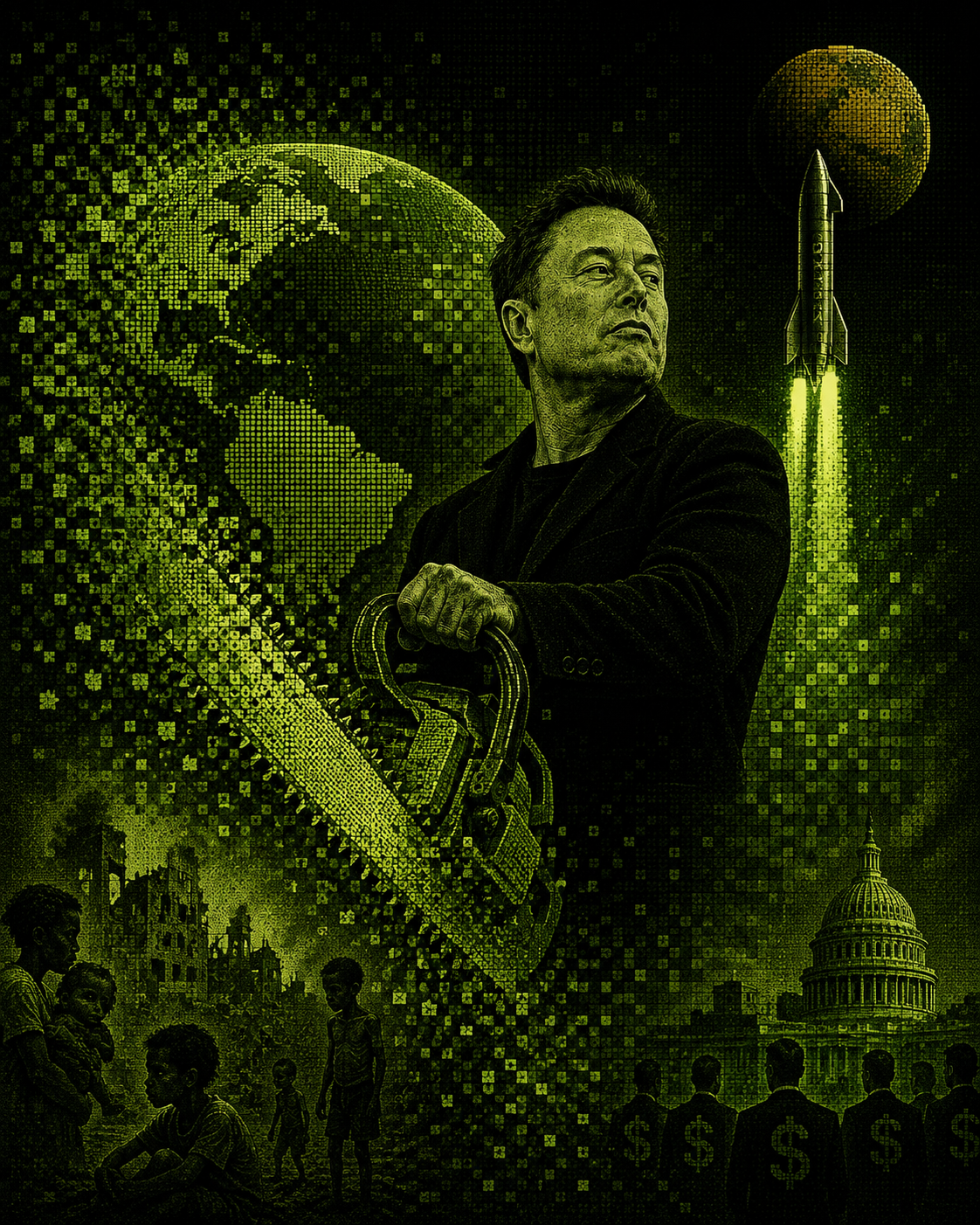
For example, during the opening months of the second Trump administration, Musk and DOGE helped dismantle USAID, one of the principal mechanisms through which the United States funded global disease prevention, nutrition, maternal health, vaccination programs, clean water, and humanitarian assistance.
The programs and efforts of USAID afforded the United States enormous goodwill and soft diplomatic avenues. Yet programs upon which human lives depended were terminated and dismantled with extraordinary speed.
Musk did not speak about this undertaking with the solemnity one might expect from someone making decisions that could affect whether distant strangers lived or died. He boasted that USAID had been fed “into the wood chipper.”
That language matters.
Because language occasionally opens a window into the moral architecture beneath a decision.
These weren’t numbers in a spreadsheet.
They were human beings.
They were simply human beings whom Elon Musk would never meet, never take into account.
And subsequent mortality estimates have attempted to calculate the human consequences of those decisions in numbers that reach into the several hundreds of thousands. The precise attribution and eventual death toll will continue to be studied and contested. The ethical question should not depend upon where the final number settles.
How many preventable deaths must follow from a government action before the architects of that action enter our moral accounting?
And perhaps more disturbingly:
Why have they not entered our economic accounting at all?
Because while people were dying, Elon Musk remained Elon Musk.
Wall Street did not place hundreds of thousands of human lives on the liability side of his personal ledger.
There was no moral deduction from his net worth.
No exchange lowered the value of his enterprises because children somewhere had lost life sustaining food and medicine.
No financial mechanism asked whether the man becoming wealthier had demonstrated wisdom, compassion, judgment or even elementary reverence for life.
Actually.
Quite the opposite.
The machinery of capital continued doing exactly what we designed it to do.
It rewarded him.
More wealth.
More power.
More access.
More influence.
More capacity to determine what happens next.
And that is the Elon Musk problem.
Not merely that one extraordinarily wealthy man may possess a profoundly impoverished conception of his obligations to that which is other than him.
The deeper problem is that we have constructed a civilization capable of rewarding him for it.
Our economic systems possess elaborate mechanisms for measuring financial value and remarkably primitive mechanisms for measuring moral consequence.
A corporation can calculate the value of a government contract to the penny.
It cannot calculate the value of the person who dies when humanitarian assistance disappears.
Wall Street can price Tesla.
It can price SpaceX.
It can price xAI.
It can apparently even price expectations about technologies that do not yet exist, just Musk pretending that they will.
But it has no ticker symbol for a child in a far off land kept alive by antiretroviral medication.
And so one counts.
The other disappears.
That is not simply a failure of capitalism.
It reflects something deeper in the moral architecture of the civilization we have built.
We repeatedly reward the human capacity to externalize suffering.
If pollution increases profit, the atmosphere absorbs the cost.
If inexpensive labor increases margins, workers absorb the cost.
If resource extraction increases shareholder value, ecosystems absorb the cost.
If eliminating humanitarian programs reduces government expenditure, distant human beings absorb the cost.
The rewards remain concentrated.
The suffering becomes an externality.
And eventually the people most capable of treating other lives as externalities acquire the greatest resources with which to shape everyone else’s future.
That should terrify us.
Because Elon Musk does not merely want wealth.
He has repeatedly presented himself as someone thinking about the future trajectory of humanity—multiplanetary civilization, artificial intelligence, population, consciousness, the survival of the species.
And here we encounter perhaps the most dangerous mythology surrounding extreme wealth:
Wealth masquerades as wisdom.
We see that someone has accumulated $100 billion, $200 billion, $300 billion and unconsciously confer upon him intellectual authority far beyond the domain in which that fortune was accumulated.
Success becomes evidence of intelligence.
Intelligence becomes evidence of wisdom.
Wisdom becomes permission to lead.
But these things are not remotely synonymous.
A person can possess extraordinary intelligence and terrible judgment.
A person can understand rocket propulsion and understand almost nothing about empathy for others.
A person can accumulate unprecedented wealth without acquiring a corresponding measure of wisdom.
Indeed, the accumulation of extreme wealth may actively work against the accumulation of wisdom.
Because enormous wealth gradually eliminates something the rest of us encounter every day:
constraint.
Fewer people can tell you no.
Fewer mistakes carry lasting personal consequences.
More eccentricities are interpreted as genius.
More cruelty is rationalized as necessary disruption.
More people become economically dependent upon maintaining your favor.
Eventually enormous wealth doesn’t merely purchase things.
It begins purchasing reality itself.
And that returns us to the $38 billion.
The moral contradiction isn’t simply that Musk benefited enormously from government while attacking government spending.
It is that Musk appears comfortable with collective resources being marshaled toward the future he values, while displaying astonishing indifference toward collective resources sustaining lives whose value he does not personally recognize.
One is investment.
The other becomes waste.
One deserves billions.
The other gets the wood chipper.
And lurking beneath that distinction is a question much older than capitalism:
Intrinsic value.
That is where my quarrel with Elon Musk ultimately lies.
And where my Transcendentalism enters the argument.
The deepest error is not that Musk sees something extraordinary within himself.
Perhaps he should.
Perhaps we all should.
The error is seeing the extraordinary within oneself and failing to recognize it in everyone else.
Consider Transcendentalist philosophy, Emerson’s self-reliance was never a theological license for narcissism. Transcendentalism’s radical proposition was that the sacred was not confined to churches, institutions, hierarchies or privileged individuals. The divine permeated existence itself.
The beggar possesses it.
The billionaire possesses it.
The child in Africa possesses it.
The engineer at SpaceX possesses it.
The immigrant possesses it.
The refugee possesses it.
The forest possesses it.
The whale possesses it.
The living Earth possesses it.
Reverence cannot stop at the boundary of the self.
And perhaps that is the true pandemic of which Elon Musk is merely our most spectacular symptom.
We have built moral, political and economic systems that continually confuse domination with strength, accumulation with achievement, intelligence with wisdom and wealth with worth.
Then we act surprised when those systems elevate people who have mastered accumulation while neglecting reverence.
The problem isn’t simply that Elon Musk has accumulated too much power.
It is that our civilization keeps telling him he deserves more.
And if the people most richly rewarded by our civilization are those most capable of placing other lives outside their circle of moral concern, then the question confronting us is considerably larger than Elon Musk.
It is whether the defect resides in the man—
or in the world that made him its richest man.
I think the honest answer is both.
Elon Musk sees the Divine.
He sees it in himself.
The world that made him its richest man has yet to demand that he recognize it in anyone else.