
An Open Letter to CEOs
To Jensen Huang, Tim Cook, Andy Jassy, Satya Nadella, Sundar Pichai, Mark Zuckerberg, and Elon Musk:
You have accomplished extraordinary things.
You have built technologies that connect continents, accelerated scientific discovery, transformed commerce, reshaped communication, and created wealth on a scale unimaginable only a generation ago. Millions of people use products and services your companies created. Entire industries now exist because of ideas that once lived only in the imagination of engineers, entrepreneurs, and visionaries.
Collectively, your companies now represent approximately one-third of the value of the S&P 500. Never before have seven private citizens exercised such influence over the technological, economic, political and informational architecture of human civilization.
Innovation deserves admiration.
Success deserves recognition.
But success has a shadow. The greater the success, the greater the responsibility—and the greater the temptation to mistake achievement for wisdom.
Somewhere along the way, many of you began speaking as though civilization itself were merely another market to disrupt.
It is not.
You did not build civilization.
You inherited it.
Long before your companies existed, generations of ordinary people built the foundations upon which your success became possible. They constructed roads and bridges. They created public schools and universities that educated your workforce. They established independent courts that protect contracts and intellectual property. They built electrical grids that power your data centers, communication networks that carry your information, and financial systems that allow capital to move across the globe with remarkable confidence.
Scientists whose names are largely forgotten conducted research funded by taxpayers. Governments invested in technologies that private industry later transformed into profitable products. The Internet itself emerged from public investment before it became the backbone of the modern economy.
Your companies did not emerge from a vacuum.
They emerged from civilization.
And civilization is not self-sustaining.
It survives only because each generation chooses to preserve and strengthen the institutions that made its prosperity possible.
Yet today, many of the world’s most successful corporations appear increasingly unwilling to support those very foundations.
Taxes become something to avoid rather than an investment in the generations to come.
Regulation becomes an obstacle rather than a safeguard against predictable human failures.
Government becomes an inconvenience rather than a partner in maintaining the stability upon which markets themselves depend.
Democratic institutions are treated as expendable if they interfere with quarterly earnings or ideological preferences.
This reflects a profound misunderstanding of how complex civilizations endure.
There is a persistent belief within certain economic circles that markets, if left sufficiently alone, naturally produce the greatest good. Competition will regulate itself. Innovation will solve every problem. Individual ambition, pursuing its own interests, will somehow create collective prosperity.
It is an elegant theory.
It is a theory that only works in a utopian society.
It is a theory that does not take into account the inherent nature of human greed.
It is a theory that assumes human beings are more morally evolved than history suggests they are.
History has been less accommodating.
Every economic system eventually reveals the psychology of the people operating within it.
No system rises above the moral development of the civilization that sustains it.
The fundamental flaw is not competition.
Nor is it ambition.
It is the assumption that human beings, left entirely to their own devices, will consistently restrain their own appetites.
They do not.
They never have.
Greed is not an unexpected malfunction within economic systems.
It is a predictable feature of human psychology.
We often disguise it with more respectable language.
We call it maximizing shareholder value.
We call it efficiency.
We call it competitiveness.
We call it market optimization.
Sometimes those descriptions are accurate.
Sometimes they are simply more sophisticated names for limitless accumulation.
The distinction matters.
Ambition builds.
Greed extracts.
Ambition creates value.
Greed consumes the conditions that made value possible in the first place.
There comes a point where success ceases to be productive and becomes parasitic.
Civilizations rarely collapse because they lack intelligence.
They collapse because powerful people become convinced they no longer depend upon the society that made them powerful.
Today, this danger has reached an unprecedented scale.
A small number of private corporations increasingly influence how billions of people communicate, what information they receive, how economies function, how elections unfold, how artificial intelligence develops, and perhaps soon, how knowledge itself is created.
Never before has so much technological power been concentrated in so few hands.
Yet many of the same voices argue for weaker democratic oversight, lower public investment, fewer institutional constraints, and greater concentration of wealth.
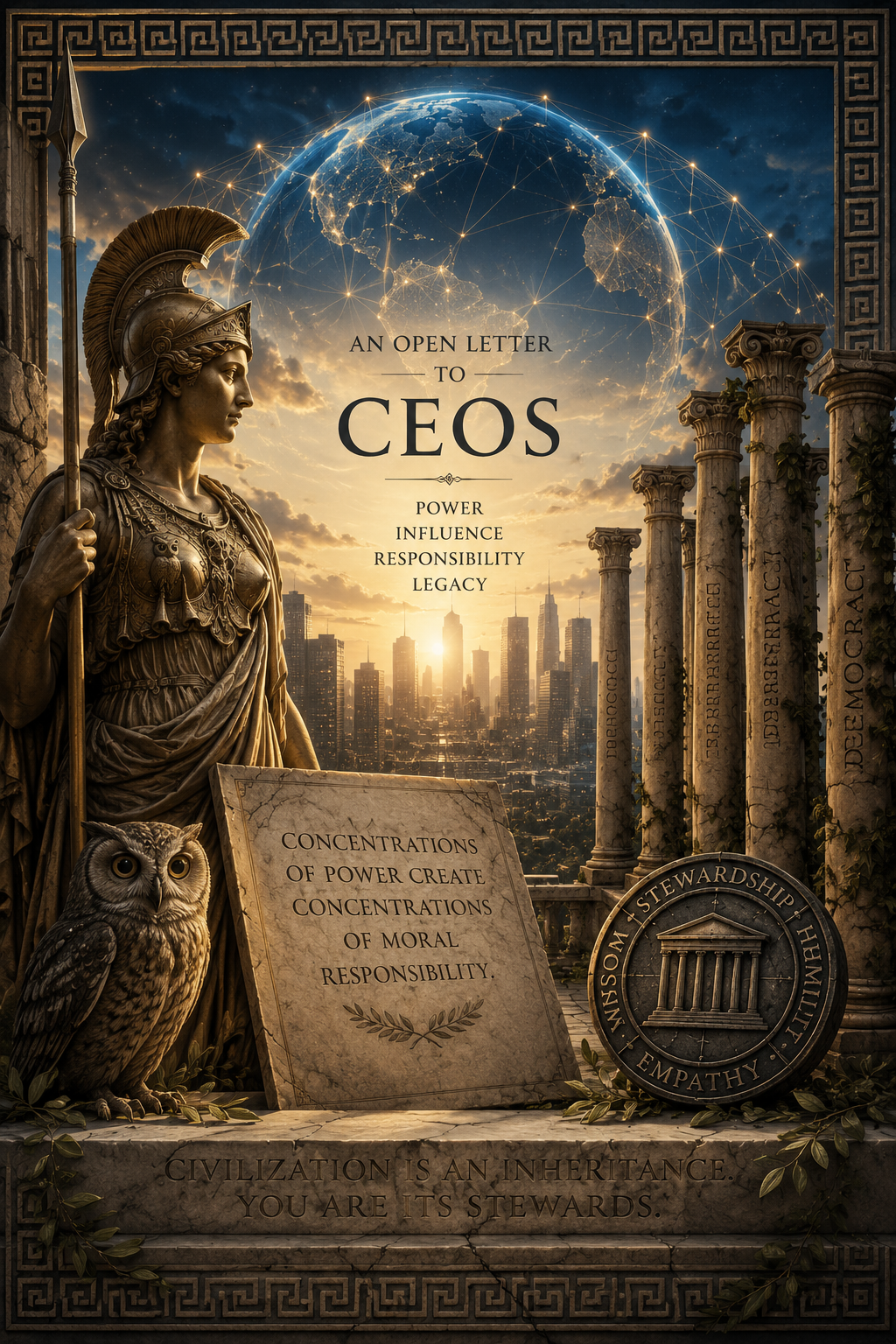
Concentrations of power create concentrations of moral responsibility.
This is not merely an economic contradiction.
It is a civilizational one.
Humanity has evolved technologically far faster than it has evolved psychologically, morally, or spiritually.
Our tools have become extraordinary.
Our wisdom has not kept pace.
Artificial intelligence, biotechnology, predictive algorithms, autonomous systems, and planetary-scale communication networks now amplify every human virtue—and every human vice.
The question is no longer whether we possess immense power.
The question is whether we possess the maturity to wield it.
This conversation ultimately extends far beyond capitalism.
Markets are tools.
Governments are tools.
Economic systems are tools.
Technology is a tool.
None of the tools we create possess conscience.
Only human beings do.
The question has never been whether humanity can create wealth.
History has answered that.
The question is whether those who accumulate extraordinary wealth also cultivate extraordinary wisdom.
Whether influence is matched by humility.
Whether power is tempered by empathy.
Whether success deepens one’s sense of responsibility rather than diminishing it.
There comes a point at which achievement ceases to be measured by what one has built and begins to be measured by what one chooses to preserve.
There comes a point at which success without stewardship is no longer merely shortsighted.
It becomes immoral.
Not because wealth itself is immoral, but because immense power always carries obligations beyond oneself.
Every civilization eventually discovers that intelligence alone is insufficient.
Innovation alone is insufficient.
Markets alone are insufficient.
Without empathy, restraint, and reverence for the larger whole, every extraordinary achievement ultimately begins consuming the very conditions that made it possible.
Growth has never been synonymous with progress.
Cancer grows.
Financial bubbles grow.
Authoritarian movements grow.
Algorithms grow.
Growth tells us only that something is expanding.
Progress asks a different question:
What is it becoming?
Human civilization is the greatest inheritance our species has ever created.
It is the accumulated wisdom, sacrifice, labor, and imagination of countless generations who built institutions they knew they would never fully benefit from themselves.
They planted forests whose shade they would never sit beneath.
They laid foundations for cathedrals whose spires they would never see completed.
They established universities knowing the greatest discoveries would belong to students not yet born.
They wrote constitutions intended to protect generations whose names they would never know.
They built roads they would never travel to destinations they could not imagine.
They funded scientific research whose greatest breakthroughs would arrive long after they were gone.
They accepted taxes not simply as a burden, but as an investment in a future they understood they would never personally inhabit.
They believed that civilization itself was worthy of sacrifice.
You inherited all of it.
The question history will ask is not how much wealth you extracted from that inheritance.
It is whether you strengthened it…
or merely spent it.
Every generation receives civilization as both a gift and a trust.
We do not own it.
We are its stewards for a brief moment before placing it into the hands of those who follow.
History rarely remembers quarterly earnings.
It remembers whether those entrusted with extraordinary power expanded the possibilities of civilization…
or merely consumed its inheritance.
Perhaps legacy has become the final currency.
Once wealth exceeds every conceivable need, the pursuit is no longer simply for more money.
It is for permanence.
To leave one’s name upon history.
To shape the future.
To be remembered.
There is nothing inherently wrong with that desire.
Every cathedral, every university, every great scientific institution, every symphony, every work of art, every civilization itself was built by people who hoped their lives would matter beyond their own lifetime.
Legacy becomes dangerous only when it is pursued without stewardship.
Without empathy.
Without reverence for the civilization that made such success possible.
Power without stewardship inevitably mistakes itself for wisdom.
Success without humility mistakes itself for virtue.
Influence without responsibility mistakes itself for destiny.
That is how civilizations begin to consume themselves.
No kingdom stands forever.
No empire escapes history.
No corporation transcends civilization.
When those entrusted with extraordinary power forget that their fortunes rest upon institutions they did not build, societies they did not create, and generations whose sacrifices they did not make, they begin dismantling the very foundations upon which their own kingdoms stand.
Your castles are built upon sand.
Eventually, even your wealth will discover that it cannot negotiate with gravity.
Civilization is that gravity.
Ignore it long enough, and even the greatest fortunes sink beneath it.
If legacy is your ambition, let it not be remembered for the size of your fortune, but for the depth of your stewardship.
Every fortune is temporary.
Every empire is finite.
Every civilization is accountable to time.
The only legacy worthy of remembrance is one that enlarges the possibilities of humanity.
Everything else becomes another forgotten thread in the tapestry of extinct ambitions.