The God Box
God Is Dead
Why God Must Stay Dead
God is dead.
God remains dead.
And we have killed him.
Friedrich Nietzsche wrote those words more than a century ago, and they remain among the most misunderstood in philosophy.
I believe he was right.
At least, the God humanity created.
Not the Creator.
The God.
The patriarch enthroned somewhere beyond the clouds. The celestial monarch who chooses nations, appoints kings, blesses armies, condemns unbelievers, concerns Himself with our sexuality, answers some prayers while ignoring others, and somehow governs an infinite universe while remaining strangely preoccupied with one species on one small planet.
That God must remain dead.
Not because the sacred is an illusion.
But because the illusion was mistaking that God for the sacred.
The Greek word hamartia, usually translated as sin, carries a far richer meaning than our modern understanding of moral transgression.
It means to miss the mark.
For centuries, humanity has debated what that mark was.
Was it obedience?
Faith?
Correct doctrine?
The proper rituals?
The proper religion?
I have come to believe we have misunderstood the mark itself.
Humanity’s greatest hamartia was mistaking a stage of development for the destination.
We crossed the bridge…
then built a civilization upon it.
We found the doorway…
then forgot there was anything beyond it.
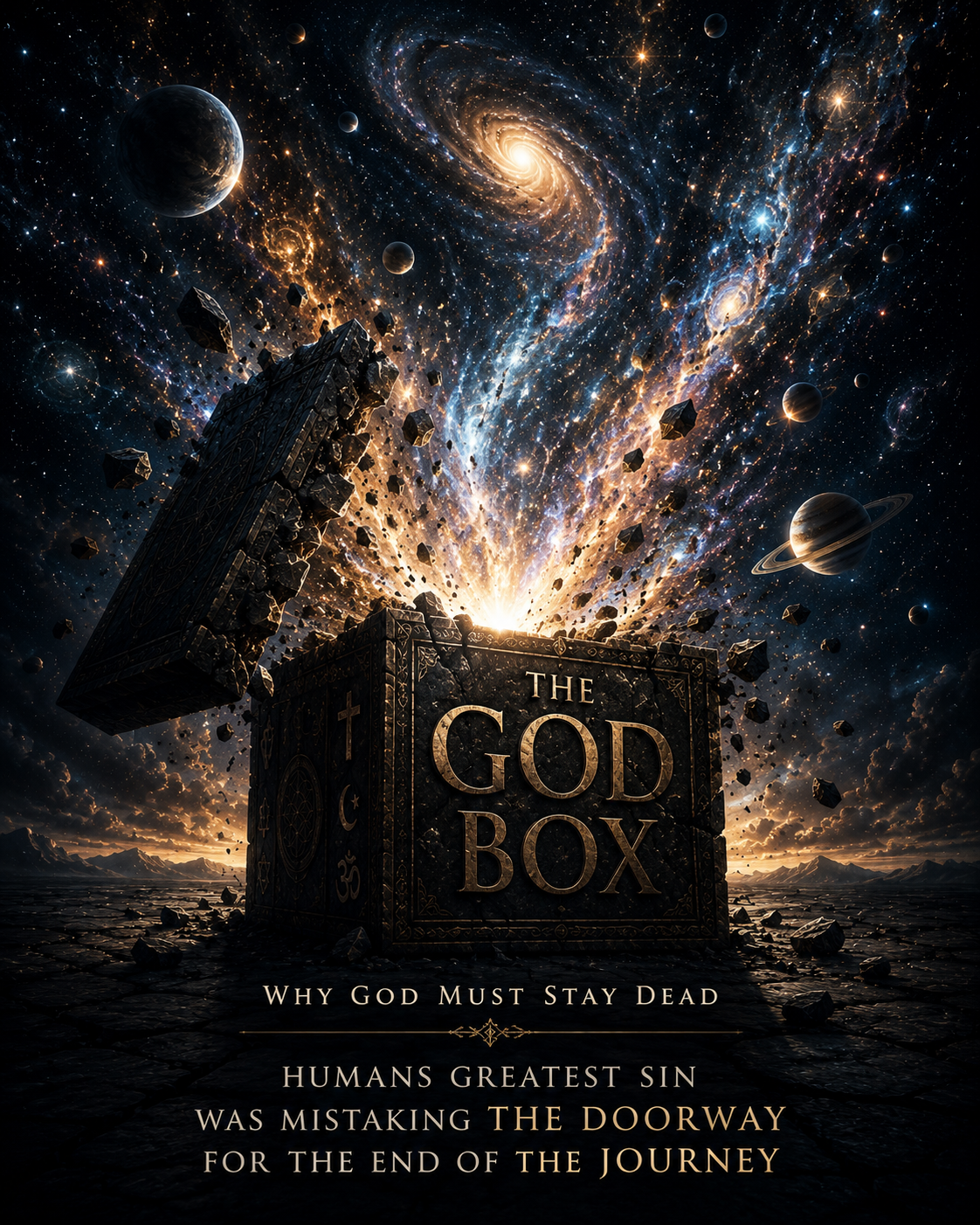
We placed the Infinite inside a box…
and called the box “God.”
Human beings have always searched for meaning.
Long before Christianity.
Long before Judaism.
Long before Islam.
Long before the Vedas were written.
Long before the Buddha walked the earth.
Long before civilizations rose along the Nile, the Tigris, and the Euphrates.
Long before writing itself.
Our ancestors stared into the night sky and asked the same questions we still ask today.
Who are we?
Why are we here?
Why do we suffer?
What happens when we die?
What is all of this?
Every civilization answered those questions with stories.
Some were eventually written.
Many were passed from generation to generation for centuries—perhaps millennia—before ink ever touched parchment or clay.
The names changed.
The languages changed.
The symbols changed.
The questions never did.
Religion became humanity’s first great language for exploring Reality.
It gave structure to mystery.
Meaning to suffering.
Community to strangers.
A moral vocabulary before psychology.
Wonder before cosmology.
It was one of humanity’s greatest achievements.
But it was never meant to be humanity’s permanent home.
Every tool has a purpose.
A bridge exists to be crossed.
A ladder exists to be climbed.
Training wheels exist to be removed.
Maps exist to guide travelers.
Language exists to point toward what words themselves can never fully contain.
Religion was no different.
It was meant to point beyond itself.
Somewhere along the way…
we stopped walking.
We built institutions around what should have remained a journey.
We defended symbols instead of seeking what they symbolized.
We canonized metaphors.
We protected doctrines.
We fought wars over signposts.
We built civilizations in the doorway instead of walking through it.
That was our hamartia.
We missed the mark.
Perhaps our greatest act of idolatry was never worshipping a golden calf.
Perhaps it was something far subtler.
We worshipped our own reflection.
Then called it God.
We gave the Infinite our face.
Our emotions.
Our politics.
Our fears.
Our tribal loyalties.
Our prejudices.
Our hierarchies.
Our need for certainty.
We imagined the Creator as an amplified version of ourselves.
Then we spent thousands of years defending the image we had made.
Measured by our current understanding, the observable universe has been unfolding for nearly fourteen billion years, possibly much longer.
The Earth formed roughly four and a half billion years ago.
Life emerged.
Species evolved.
Entire worlds of living things appeared and disappeared.
Only very recently did Homo sapiens arrive.
We arrived astonishingly late to the story, yet almost immediately assumed it had always been about us.
And before long we concluded that the Infinite looked remarkably like us.
Reality may prove to be older than our present cosmology suggests.
It may encompass dimensions, processes, or forms of existence beyond anything we are presently capable of imagining.
Yet despite our profound ignorance, we have repeatedly declared with absolute certainty what the Infinite is, what it wants, who it loves, who it hates, and what happens after death.
That is not humility.
It is breathtaking anthropocentrism.
The irony is almost unbearable.
Religion was meant to cultivate humility.
Instead, it often cultivated certainty.
It was meant to inspire compassion.
Instead, it has too often justified cruelty.
It was meant to awaken reverence.
Instead, it frequently demanded obedience.
It pointed toward mystery.
We built dogma.
It pointed toward the Infinite.
We built walls.
Some years ago my former mother-in-law accepted a ride from a stranger after her car broke down.
Before putting my young daughters into his vehicle, she explained to me afterward that she trusted him because he told her he was a Christian and that God had called him to help people.
“It was God’s will.”
“It was God’s protection.”
“It was God’s plan.”
I remember saying something that has stayed with me ever since.
“It’s always God or the Devil.
It’s never you.”
Personal responsibility was quietly relinquished.
How many wars have been fought because God wanted them?
How many elections decided because God chose the candidate?
How many children rejected because God condemned them?
How many acts of cruelty justified because someone claimed divine certainty?
When responsibility belongs to God, human beings stop asking whether they are responsible.
I cannot separate the Creator from Creation.
I have come to believe they are not separate..
The unfolding of galaxies…
the birth of stars…
the emergence of life…
the evolution of consciousness…
the thoughts moving through your mind as you read these words…
none of these exist outside the Creator.
They are the Creator in continuous expression.
Language forces us to divide Reality into nouns.
Reality itself may not be divided at all.
Stories are not the problem.
Every civilization tells stories.
Stories carry memory.
Meaning.
Identity.
Wisdom.
Hope.
The problem begins when stories become prisons.
When symbols become idols.
When metaphors become unquestionable facts.
When the finger pointing toward the moon becomes more important than the moon itself.
When the Infinite is reduced to the limits of human comprehension—and then demands worship.
Nietzsche declared that God is dead.
I believe he was only half right.
The God humanity created is dead.
And if humanity is ever to evolve…
that God must remain dead.
Not because the Creator has disappeared.
But because the Creator never lived inside the box.
We did.
Perhaps hamartia—missing the mark—was never about failing to obey God.
Perhaps humanity’s greatest failure has been refusing to outgrow the very tools that first taught us how to seek Truth.
The mark was never belief.
The mark was never certainty.
The mark was never defending the box.
The mark has always been becoming.
And perhaps the next stage of human evolution begins the moment we finally gather the courage to step outside the God Box.