Humans Being: The Paradox of Human Existence: A Species at a Crossroads
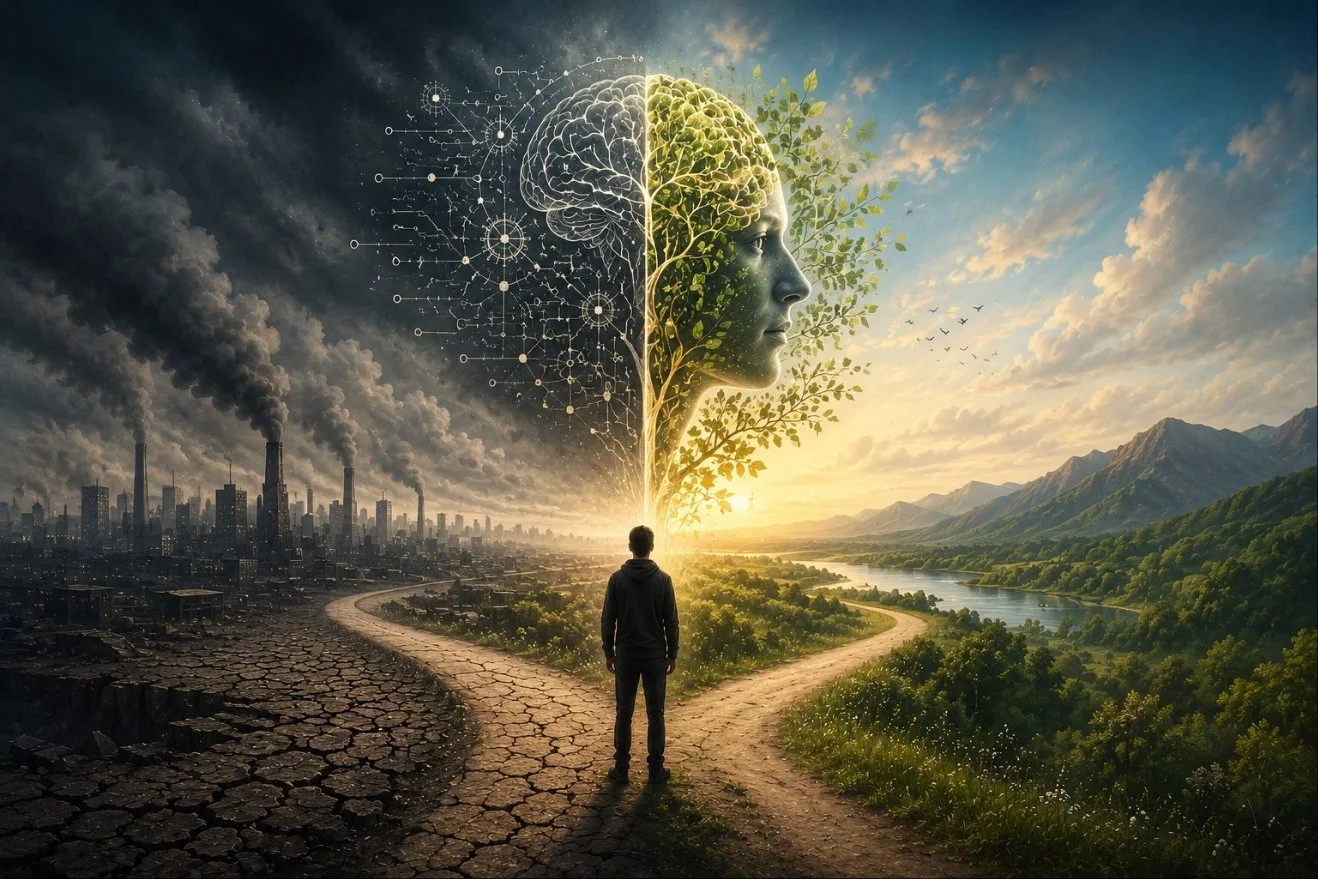
Humanity is a paradox—an apex species poised at the edge of unfathomable complexity, yet tethered to the remnants of a primordial mind. We stand at a precipice, convinced we are ascending, convinced that perpetual progress is our birthright. Yet humans are not an evolved species, at least not in the ways that matter most. Humanity has evolved technologically far faster than it has evolved psychologically, morally, or spiritually.
The Cosmic Tapestry holds within its threads the stories of civilizations rising and civilizations falling, and humanity imagines itself the pinnacle of creation rather than simply the latest iteration woven into a pattern far older and far wiser than we are willing to admit. Observing humankind, one finds rational beginnings meeting irrational ends: a species capable of sculpting beauty, curing disease, sending instruments to the solar system’s edges, and peering into the earliest moments of the universe—yet equally capable of unspeakable cruelty, wanton destruction, shortsighted exploitation, and an almost limitless capacity for denial.
This is the tension that defines our age—the chasm between our evolutionary potential and our destructive tendencies. We love, but we also hate; we build, but we also destroy; we invent, but we also waste; we connect, but we also divide. The arc of human history reveals a species that has risen from firelit caves to crafting technologies whose implications our primordial neural architecture can barely comprehend. Yet within this ascent lies the seed of collapse: an arrogance shadowing our brilliance, a blindness masquerading as dominion.
Still, the brilliant and the beautiful, the darkness and the destruction, are all woven into the unfolding pattern of the Cosmos. Each is a thread of experience. The question is not whether humanity possesses greatness. The question is whether we possess the wisdom necessary to survive our own power. What threads do we have yet to weave? And will the ones we choose now guide us toward continued ascent, or inscribe the beginning of our tragic unraveling?
Hubris, once merely a byproduct of our halting evolution, has become an innate characteristic of humanity—a frayed thread we cling to even as it cuts into us. Our denial of personal and collective responsibility to evolve generates the very hubris that hinders our evolution, creating a closed loop of stagnation. From this emerges an immorality born of blindness, an incapacity to learn from history, and a growing inability to distinguish reason from rationalization. Humanity clings to a distorted sense of superiority, warping its own vision until deeper realities become invisible. This distortion of our place in the universe keeps us trapped in patterns that no longer serve us, preventing us from stepping into possibilities we have yet to fathom.
Hubris is among humanity’s oldest afflictions.
Again and again, civilizations convince themselves that they have transcended the limitations that governed those who came before them. They imagine themselves uniquely enlightened, uniquely powerful, uniquely immune to consequences. History records what follows with remarkable consistency. Reality eventually reasserts itself.
The danger is not ignorance. Ignorance can be corrected. The greater danger is the illusion of knowledge—the conviction that we already understand the world as it is. Once individuals or societies become convinced of their own infallibility, they lose the capacity for self-correction. Evidence becomes inconvenient. Criticism becomes hostility. Reality itself becomes negotiable.
Perhaps the defining characteristic of modern civilization is not knowledge but delusion.
We have constructed elaborate stories about who we are, what we deserve, and where we are headed. We tell ourselves that endless growth is possible, that prosperity can be separated from consequence, that technology will solve problems faster than we create them, that power is evidence of wisdom, and that comfort is proof of progress. These assumptions have become so deeply embedded within our culture that they no longer appear to be beliefs. They appear to be reality.
Yet reality continues to accumulate outside the boundaries of the stories we tell.
The true crisis of our age is not political, economic, or technological. Those are symptoms. The deeper crisis is perceptual. Humanity is increasingly confronted by evidence that its assumptions are wrong while simultaneously becoming more resistant to acknowledging that fact. We are not suffering from a lack of information. We are drowning in information while losing our ability to distinguish reality from narrative, truth from ideology, wisdom from certainty.
Humanity’s greatest delusion may be the belief that intelligence alone makes us evolved.
Intelligence has given us power. It has enabled us to reshape landscapes, alter ecosystems, split the atom, decode the genome, and build machines that increasingly mirror aspects of our own cognition. Yet power without wisdom is not evolution. Knowledge without self-awareness is not evolution. Technological sophistication without moral maturity is not evolution.
An evolved species would recognize its dependence upon the larger web of life. An evolved species would understand that power without wisdom is dangerous. An evolved species would think beyond the next election, the next quarter, the next generation. An evolved species would not repeatedly place itself on a path toward predictable catastrophe while convincing itself that somehow this time will be different.
Our problem is not a lack of intelligence.
Our problem is our inability to see ourselves clearly.
We have mistaken our ability to control for our ability to understand. We have mistaken knowledge for wisdom. We have mistaken technological sophistication for genuine evolution. In doing so, we have become increasingly blind to a reality that stands directly before us.
The greatest threat facing humanity may not be climate change, war, authoritarianism, artificial intelligence, or ecological collapse.
The greatest threat is our unwillingness to confront what those crises reveal about us.
Until humanity learns to see itself clearly—to recognize both its extraordinary potential and its profound limitations—it will remain trapped within the same cycles that have defined its history. The future of our species will ultimately depend not upon what we can build, but upon what we are willing to become.