

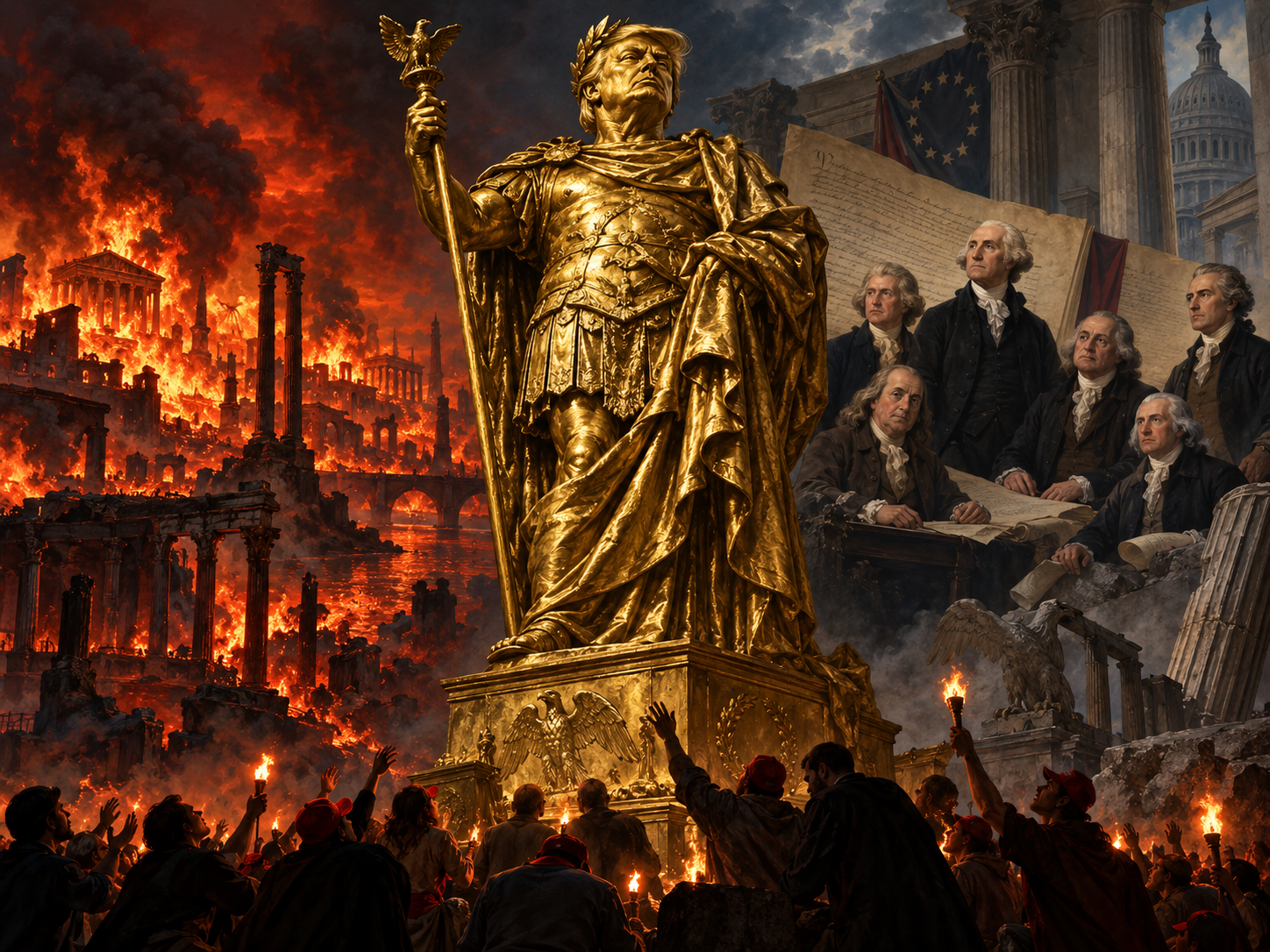
Rome is burning.
Not the ancient city consumed by the Great Fire of 64 CE, but the American Republic—its democratic institutions weakened, its guardrails strained, its trust eroding. And while it burns, the president presides over a Washington increasingly remade in his own image: gold ornamentation, an enormous new ballroom, a monumental triumphal arch, his name placed upon national institutions, monuments conceived on an imperial scale. The imagery is impossible to ignore.
It is our Nero moment.
The familiar image of Nero fiddling while Rome burned is almost certainly myth. Nero was not even in Rome when the fire began, and ancient accounts describe him returning to organize relief. But myths survive because they can become more powerful than the complicated human beings beneath them.
And the mythology of Nero contains more than the fire. It tells of a young emperor whose rule descended into something darker—an increasingly grandiose ruler obsessed with spectacle and adulation, suspicious of rivals, brutal toward perceived enemies, convinced of his own artistic magnificence and of his own personal magnificence. He ordered the death of his mother, Agrippina; after a conspiracy against him was uncovered, prominent Romans including his former adviser Seneca were forced to die. His appetite for performance and personal glorification grew as he and his reign became increasingly unstable. After much of Rome burned, he constructed the extravagant Domus Aurea—the Golden House—on land opened by the devastation.
Modern historians have complicated that portrait considerably. The surviving literary accounts were written after Nero’s death, often by authors deeply hostile to him, and some of their most sensational allegations may be exaggeration or invention. But that is precisely why the mythology matters. Nero became the enduring image of a ruler disappearing further into spectacle, grievance, cruelty and self-glorification while the world entrusted to him deteriorated around him.
Trump’s rise to political power was built upon mythology of its own.
The Art of the Deal created the image of Trump as the master negotiator—the brilliant businessman who always knew how to win. But Tony Schwartz, credited as co-author, spent more than a year writing the book and later said Trump changed almost nothing in the manuscript. Trump disputes that account and maintains that he wrote the book. The mythology was then magnified exponentially by The Apprentice. Its imposing boardroom was a stage set. Trump was photographed from low angles, his entrances choreographed, his decisions edited into coherent television narratives. Trump never made the decisions over who would be fired. America spent years watching Trump play the role of the all-powerful executive; that role was a reality show myth, but the imagery took hold.
The comparison is not that Trump is Nero or that twenty-first-century America is ancient Rome. It is about the political power of mythology—and what happens when the mythology surrounding a leader becomes more compelling than the reality beneath it. It is about what happens when that compelling mythology hastens the decline of an empire.
The myth of the accomplished businessman eventually became the myth of the political genius—the outsider who alone could bend Washington to his will.
But Trump never held any allegiance to one political party, his party affiliation was rather fluid. He had been a registered Democrat and donated to the political campaigns of Democrats, such as Hillary Clinton and Chuck Schumer.
Trump did not create the conditions that made his rise possible.
The complete capture of the Republican Party was the culmination of transformations that had been taking place for decades. There is a wide range of dynamics that facilitated the takeover. The advent of social media and the flood of misinformation played a large role. Social media was just the fuel on the brewing flame, a new way for placing propaganda and extremism on blast.
For decades the ingredients for domination of our democratic institutions evolved: the growing political power of the religious right; the elevation of cultural grievance over governing philosophy; the backlash surrounding the Obama presidency; the Tea Party; birtherism; the normalization of conspiracy; and ultimately the willingness of a major political party to tolerate increasingly anti-democratic behavior so long as it produced political power.
Trump did not invent all of these forces. He did recognize their power.
And eventually, they recognized his.
That is where the story of Trump becomes inseparable from the story of the Republican Party.
How did a party that once identified itself with constitutional restraint, limited government, institutional stability and individual liberty become increasingly willing to concentrate power in the presidency?
How did political disagreement become grievance, grievance become identity, and identity become loyalty to one man?
How did ideas once confined to the ideological edges—Christian nationalism, sweeping theories of presidential authority, hostility toward independent institutions, and the treatment of political opponents as enemies—move into the machinery of government?
And at what point does authoritarian drift become something more?
Scholars of fascism including Jason Stanley and Timothy Snyder have argued that contemporary Trumpism displays recognizable features of fascist politics: the myth of a lost national greatness, the exaltation of the leader, the creation of internal enemies, attacks upon independent sources of truth, the celebration of domination and force, and the subordination of law to political power. Snyder now writes explicitly of an attempted “fascist transition.”
Whatever terminology Americans choose to describe it, the institutional deterioration itself is measurable. The V-Dem Institute reports that the United States experienced an unprecedented decline in liberal democracy during 2025, with particularly severe deterioration in legislative constraints on executive power, rule of law, freedom of expression and protections for dissent.
To understand how we arrived here, we have to look beyond Trump.
We have to look at the party that was ready for him.
The transformation of the Republican Party did not begin with Trump, and it did not happen overnight. Trump did not create the conditions for the rise of a demagogue. He was the beneficiary of decades of political, religious, cultural and institutional change that had already altered what the Republican Party was—and what it was willing to become.
Ronald Reagan was a different kind of Republican than his predecessors. Reagan began blurring the lines between church and state. He helped consolidate the modern alliance between the Republican Party and the religious right. But it was during the presidency of George W. Bush that the relationship between faith and government became significantly more institutionalized.
Bush was not a Christian nationalist. His religious faith was sincere and central to his understanding of himself and the world. But personal faith increasingly entered the language and machinery of government, infiltrating government policy.
Only days after taking office in 2001, Bush created the White House Office of Faith-Based and Community Initiatives and directed federal agencies to remove barriers preventing religious organizations from competing for federal grants and contracts. His administration explicitly sought to make faith-based organizations partners in delivering federally funded social services. Seven years later, the Bush White House called the initiative a “quiet revolution” and reported that thousands of religious and community organizations had received federal funding.
The constitutional safeguards were supposed to prevent federal money from financing worship or proselytizing. But something important had nevertheless shifted: religious organizations were no longer merely influencing public policy from outside government. They had become formal partners with government, eligible for public funding while retaining their religious identities and mission.
My objection is not that faith-based organizations are religious. They have every right to be. My concern begins when public funds support organizations that provide services families may genuinely need—after-school care, food assistance, tutoring, community programs—while those same organizations also carry an explicit religious mission.
The political right is quick to condemn what it calls “indoctrination” in public schools and universities. But when religious instruction is introduced through publicly supported programs, the objection seems to disappear.
Parents should not have to choose between needed services and exposing their children to evangelizing. This further blurred the line that is constitutionally drawn between church and state.
After September 11, the line between religious conviction and the exercise of American power became more visible still.
Bush repeatedly framed the emerging war on terrorism in stark moral terms—good against evil, freedom against those who hated it. On September 16, 2001, speaking about what would become the global war on terror, he referred to “this crusade.” The word was quickly walked back, but its historical and religious resonance was impossible to miss. His administration later emphasized that terrorism—not Islam or any religion—was the enemy, but the language surrounding the conflict often carried a distinctly theological moral weight and sent a shiver down the collective spine of the Islamic world.
None of this made George W. Bush an authoritarian or a Christian nationalist. But it helped further normalize something that would become increasingly important within Republican politics: the idea that religious identity, American national identity and political power could comfortably occupy the same space.
During the 2008 presidential campaign came the canary in the coal mine, Sarah Palin.
Palin’s brand of politics was cultural identity—with no expertise, no policies, no qualifications and practically no knowledge of the country and its history that she was campaigning to help govern.
Her emergence as John McCain’s running mate in 2008 represented a shift in Republican political culture. Policy fluency mattered less. Expertise of any sort became suspect. Cultural identity mattered more. She spoke of “the real America,” positioned herself against elites, celebrated grievance as authenticity, and made resentment toward the political and cultural establishment part of the performance.
Palin transformed politics into something closer to a reality television production.
The appeal was not simply ideological. It was emotional. She told an audience that their frustration was proof that they understood the country better than the people who governed it, better than “elites” on the Democratic side. Politics became less about competing philosophies of government and increasingly about which America was the “real” America—and who therefore had the right to claim it.
Then Barack Obama was elected president.
His presidency would be an accelerant for forces already developing inside the Republican coalition.
The Tea Party emerged publicly around government spending, taxation, the federal deficit and a particular opposition to the Affordable Care Act (ObamaCare). Those concerns were real. The movement demanded lower taxes and smaller deficits at the same time, often without confronting the fact that tax cuts themselves must be financed. Fiscal responsibility became less a coherent governing philosophy than a political weapon—invoked against Democratic spending while Republican tax cuts were treated as inherently virtuous.
But the movement was never purely economic. Pew found that Tea Party supporters were also disproportionately socially conservative, heavily Republican and unusually likely to come from white evangelical Protestant communities. In the 2010 midterms, Tea Party supporters made up 41 percent of voters, and 86 percent of them voted Republican. The movement helped Republicans retake control of the House.
The Tea Party changed the incentives within the Republican Party. And Republicans fully weaponized the grievances.
Compromise increasingly became unacceptable. Republican officeholders had more to fear from a primary challenge on their right than from losing voters in the political center. Increasingly, party loyalty to an ideology was required to remain in office. There would be increasingly less bipartisanship. Governing itself could be portrayed as capitulation; it was more important to disenfranchise everyone they do not view as a “real” American and harm liberals.
The majority of low-information voters who accept policies that are not in their own interest identified increasingly as Republican. Policy that would truly benefit millions across the spectrum of voters, like the ACA, would stir vitriol and protests with signs portraying death panels and telling Democrats in the majority to “get their government hands off my Medicare,” apparently not realizing that Medicare is government-backed healthcare.
The opposition to Obama frequently became something more personal and dark than simply legitimate opposition to policy.
That is where Trump reenters the story.
Trump had changed political affiliations repeatedly over the years. He had been registered as a Democrat as recently as 2009. He was not the product of a lifelong conservative intellectual tradition.
But by 2011, he discovered something. He had something other possible candidates did not. Trump was in the middle of a reality television career that for over ten years projected the myth of a highly successful businessman on NBC’s The Apprentice franchise. The persona was certainly a made-for-television image, a reality show myth.
The birtherism conspiracy was in the air. Trump seized on the growing tribalism and gave the conspiracy theory a national megaphone. He repeatedly questioned whether Barack Obama had been born in the United States and therefore whether the first Black president was constitutionally entitled to occupy the office at all.
The claim was absolutely false. Obama had been born in Hawaii. Trump knew this but that did not matter. And Trump’s embrace of birtherism did something politically important: it harnessed the rising tribalism and propelled him into the top tier of early Republican presidential speculation.
Contemporary reporting described senior Republicans trying to distance the party from the conspiracy even as Trump was gaining attention precisely because he was promoting it. That would change.
Trump learned something about the Republican electorate before he ever formally entered presidential politics.
Grievance worked.
Conspiracy worked.
The delegitimization of political opponents worked.
The bluster, bullying and misogyny worked.
And perhaps most importantly, Trump discovered that a significant portion of the Republican base did not want someone to moderate those impulses.
They wanted someone to amplify them. And Trump was about to bring all of those impulses into the Oval Office.
By the time Trump descended the escalator at Trump Tower in 2015, the Republican Party had already undergone a transformation. The religious right had become integral to the coalition. Cultural grievance had become increasingly important to political identity. The Tea Party had rewarded confrontation and punished compromise. Birtherism had demonstrated the political power of conspiracy and delegitimization. Conservative media had created an echo chamber in which outrage could be sustained almost indefinitely. Social media put tribalism and conspiracy theories on blast.
The far right was primed for a demagogue to enter the political arena.
Trump stepped up.
And he possessed something the politicians who came before him did not: decades of celebrity, an instinct for spectacle, a gift for conning, almost no attachment to ideological consistency, a willingness to cross boundaries, scoff at norms and carry no allegiance to the Constitution.
The Republican establishment initially believed it could control him.
Instead, he consumed it.
What followed was not simply the Republican Party moving further to the right. It was a transformation in what the party demanded from its leaders.
Any conventional Republican politicians still in office would one by one fall in line or leave the party.
Political loyalty increasingly became personal loyalty.
Republicans who opposed Trump did not merely disagree with the party leader; they risked being branded traitors, censured, primaried or driven from office. Policy positions that had once defined Republican orthodoxy could change when Trump changed his position. Free trade could become tariffs, suspicion of Russia could become a witch hunt, and any idea around fiscal conservatism could disappear. There was no longer any ideological consistency outside of one personality.
The consistency became Trump.
And that is where the story changes again.
The forces that had prepared the Republican Party for Trump eventually found in him something they could use as well: a political figure with an enormous following, little reverence for institutional restraints, and an appetite for complete executive power.
Trump provided the celebrity.
The Republican Party, Christian Evangelicals and MAGA—Make America Great Again—would provide the legitimacy.
Not legitimacy in the constitutional sense. Trump had already won elections and held office through the mechanisms of the American system. What they provided was something more powerful politically: permission.
They made conduct considered disqualifying for any other political figure acceptable. They reframed cruelty as strength, grievance as patriotism, conspiracy as skepticism, loyalty to one man as loyalty to country. Religious leaders supplied moral cover. Republican officials supplied institutional cover. MAGA supplied the emotional energy of a mass movement, a cult of personality.
Each constituency gave something different, but together they transformed Trump from a political aberration into the organizing center of a major American party.
And once that happened, the question was no longer simply what Trump was willing to do.
The question became what the people and institutions surrounding him were willing to excuse, defend, enable—or help accomplish.
And this is where the transformation of the Republican Party became something more than political evolution.
It became betrayal.
Republicans presently control both houses of Congress. They are not powerless spectators watching an executive branch accumulate authority. Congress possesses enormous constitutional power precisely because the Framers understood that presidents could not be trusted to restrain themselves.
Yet again and again, the institution designed to check executive power has subordinated itself to the man exercising it.
That distinction matters.
The danger comes when supporters of the demagogue stop demanding those restraints—and when the people entrusted with enforcing them decide that loyalty to a leader matters more than loyalty to the Republic.
That is a cult of personality.
Congress has not become impotent because the Constitution failed to give it power. It becomes impotent when its members refuse to exercise the power the Constitution gave them.
The Founders understood this danger.
They knew the demagogue could pose the greatest threat to the Constitutional Republic.
They knew that republics could be undone by ambitious men who understood how to harness grievance, fear, faction and popular passion. They knew that political leaders could place personal power above the common good. They knew that liberty could not depend upon the virtue of the person occupying the executive office.
That is why they built checks and balances into the structure of the Republic.
James Madison warned that merely writing limits on power onto parchment would never be sufficient. The branches of government had to possess both the constitutional means and the institutional will to resist one another.
“Ambition must be made to counteract ambition.”
The system assumes that Congress will defend the authority of Congress.
It assumes that senators will defend the Senate.
It assumes that representatives will defend the House.
It assumes that members of both parties will understand that their obligation to the Constitution ultimately outranks their obligation to a president, a political party, or their own reelection.
The Constitution can provide the mechanism.
It cannot provide the will to use it.
And that may be the most profound betrayal of this moment.
But responsibility does not end with the Republican Party.
It extends to us.
People voted for Trump for many different reasons. Some voted on immigration, taxes, abortion, inflation, judges or foreign policy. Some distrusted Democrats. Some wanted disruption. Some were angry. Some genuinely believed he would improve their lives. And some of the people dearest to me have supported him and sincerely believe that he is a good man.
I respect their right to reach their own conclusions.
But voting is not merely an expression of personal preference.
We are choosing who will exercise the enormous power of the presidency of the United States.
That decision reaches into virtually every part of our lives: whether we can afford healthcare, how our children are educated, what protections workers receive, our health and food safety, how our economy functions, how taxes are collected and spent, what rights government protects, whom we send to war, how we treat immigrants, whether our alliances endure, and whether the institutions of democratic government remain strong enough to restrain the people we place in power.
And because the United States remains the largest economy in the world and one of the most consequential centers of military, financial and political power, the consequences of our presidential elections extend far beyond our borders. Who we place in the Oval Office matters not only to the stability of our own democracy, but to global economic stability, international alliances, war and peace across the world.
That is an extraordinary responsibility to carry into a voting booth.
That is an extraordinary amount of power to place behind a single vote.
We should treat it accordingly.
Because we are Americans.
Voting should never be reduced to political fandom, resentment toward the other side, a candidate’s entertainment value, the price of groceries in a particular month, or the satisfaction of making people we dislike angry. Nor should allegiance to a political party relieve us of the responsibility to examine the character, conduct, competence and intentions of the person asking us to entrust them with power.
A republic asks more of its citizens than choosing a side.
It asks judgment.
It asks attention.
And sometimes it asks us to place the preservation of the system itself above the victory of the party we ordinarily support.
I have told people I love that I respect their right to believe Trump is a good man.
But I can never share that judgment.
For me, the public record—his conduct toward women, immigrants, political opponents, business, democratic institutions, the truth itself, and his own use of power—makes that conclusion impossible to reconcile with the mountain of evidence of who this man is. The evidence grows stronger every day. Trump is a highly immoral, unethical and corrupt authoritarian leader.
The more important question, however, is larger than Trump.
A democracy should never depend upon electing only good men.
The Founders understood that. They understood that there are men whose own interests and willingness to manipulate the levers of our government institutions could pose a grave danger to the republic.
That is why they gave us institutions designed to restrain the ones that would go too far, to restrain a demagogue.
Where does this leave the American Democratic Republic now?
During Trump’s first term much damage was done to our institutions, our relationship and reputation with our allies, our relationship to one another. We could have significantly recovered from a one-term Trump presidency. Then Trump’s supporters and the Republican Party voted in 2024 to return him to the Oval Office despite his having incited an insurrection on January 6, 2021 and in the interim he became a convicted criminal about to be sentenced. And in these first two years of another Trump presidency an enormous amount of damage has been done to the whole of our government, our institutions and to the Republic as a whole.
Agencies across our government have been significantly weakened. There have been mass firings and others having chosen their professional integrity over serving this administration. This has led to massive systemic loss of generational expertise across the whole of the federal government. The loss of experience and knowledge in the Department of Justice, particularly in the FBI and cybersecurity within this department and the Department of Homeland Security has an immeasurable impact on our national security.
Immeasurable until it becomes measurable.
Our allies no longer trust us. The first time we elected Trump it was thought, hoped, this is just a bug, not a feature. Electing Trump a second time sent the message that this is who we are now. Our allies are moving forward with new strategies, new alliances to function in a world where the United States is no longer reliable. This makes us vulnerable, weaker, less relevant on the world stage.
We are no longer a functioning democracy. That is an extremely difficult statement to make, and honestly, it breaks my heart to do so. This is our reality. That does not mean we have to make it a fixed reality.
Keeping a liberal democracy also requires healthy political opposition. Political parties can—and should—be at odds over policy. But for democracy to function, they must remain committed to the democratic system despite individual differences. In practice, that means accepting legitimate election outcomes; allowing institutions to constrain their own side; expecting Congress to check presidents of either party; maintaining an independent judiciary and a free press; protecting civil liberties and minority rights; and, crucially, recognizing political opponents as legitimate participants in democracy rather than enemies who do not deserve to be considered American.
Democracy requires continuous debate and healthy disagreement.
What it cannot survive indefinitely is a political movement that decides retaining power matters more than preserving the democratic system that grants it power. And there is a shift taking place among Trump supporters. The economy for the individual is hurting with prices on everything essential soaring. One primary factor that is driving this is the unconstitutional tariffs Trump, without any logic or reasoning, placed on anything he felt like. The more impactful factor is Trump, and Trump alone is responsible for the war with Iran and the resulting closure of the Strait of Hormuz, creating global economic instability and sending energy costs soaring.
As Professor Eddie Glaude Jr. noted, we have an epidemic of selfishness. Voters could vote for Trump as long as it was hurting someone other than themselves. Then it hit their pocketbook. Now many Trump supporters feel betrayed.
We do have a few levers left to return our government institutions to a democratic system, one that holds faith in and a commitment to the rule of law.
We still have the fourth estate, the free press.
We still have freedom of speech and expression.
We still have—not the Supreme Court, but federal judges who have been holding the line.
And we still have the right to vote.
I hear the phrase quite often: “Democracy is not a spectator sport.” It isn’t. A healthy democracy requires participation. But participation alone is not enough.
The V-Dem Institute, based in the Department of Political Science at the University of Gothenburg in Sweden, defines liberal democracy as requiring more than elections. It requires civil liberties, rule of law, an independent judiciary, and effective checks and balances capable of constraining executive power.
There is still time.
But preserving a republic has never been a passive act.
The Founders understood that institutions alone could not save us. They divided power, constructed checks and balances, protected political speech and created a system intended to frustrate the ambitions of any one person who sought too much power.
But they could not write fidelity into the Constitution.
They could not guarantee that members of Congress would defend the authority entrusted to them.
They could not guarantee that citizens would recognize a demagogue when one appeared.
They could not guarantee that we would value truth over propaganda, principle over party, or the Republic over the temporary satisfaction of defeating people we have been taught to hate.
They could only give us the tools.
Whether the next generation has a democratic republic has always depended upon us.
So wake up.
Pay attention.
Speak.
Write.
Protest peacefully.
Support a free press.
Demand that Congress defend its constitutional authority.
Defend the rights of people with whom you disagree.
Hold your representatives accountable.
Hold your own political views accountable.
And vote as though the Republic depends upon it.
Because it absolutely does.
When American socialite Elizabeth Willing Powel asked Benjamin Franklin what the Constitutional Convention had given the American people—a republic or a monarchy—his answer contained both the achievement of the Founders and their warning to every generation that would follow:
“A republic, if you can keep it.”
They granted us, the American people, something extraordinary that had never before in history been accomplished.
Now it is our turn to cherish that gift.
Rome is burning.
The Republic is still ours to keep.