

Iran is Winning: Trump’s Historical Blunder
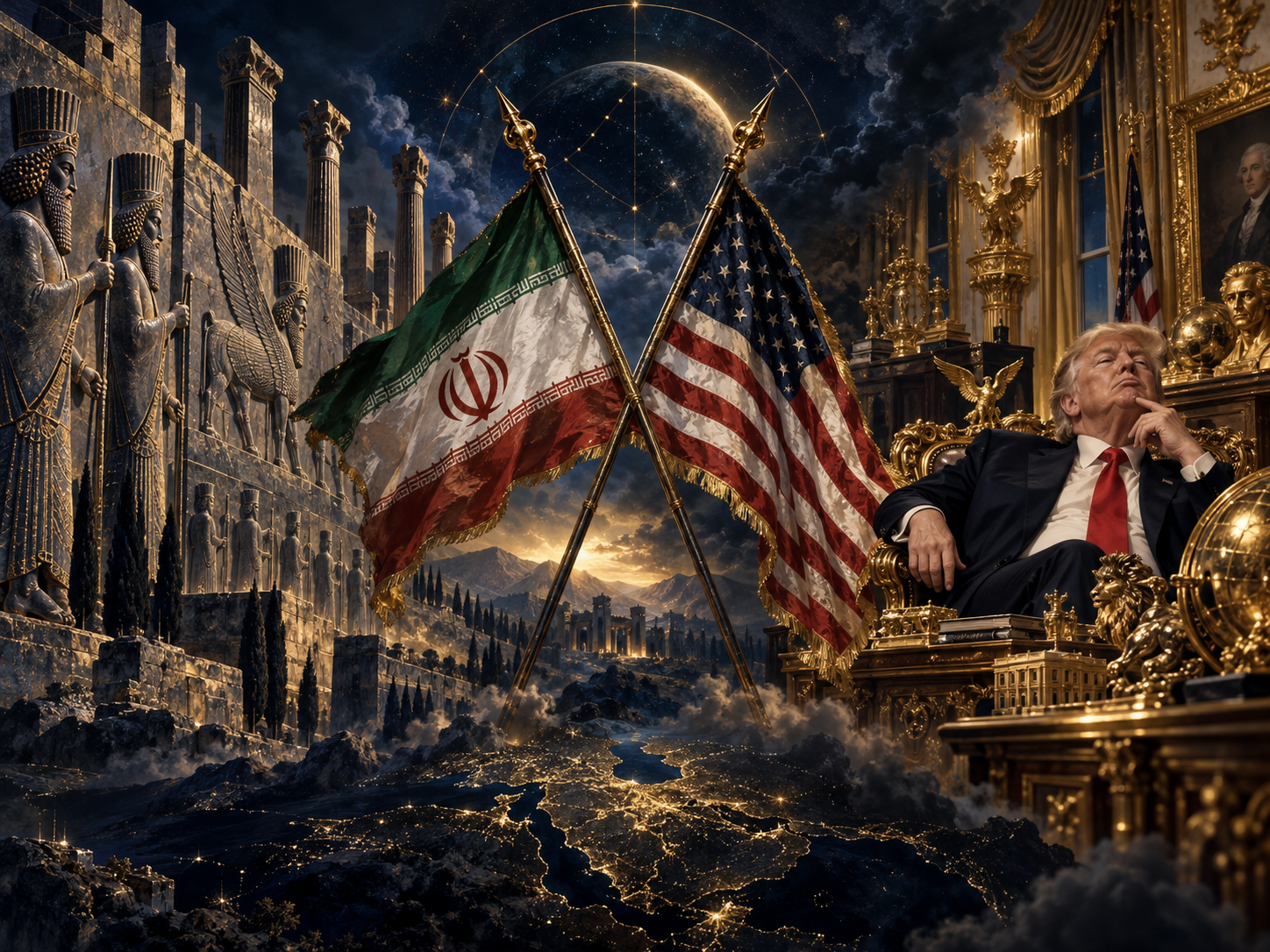
Trump is an astoundingly ignorant man. He is particularly ignorant of the culture, the history and the regime in charge of the country that he has taken our country to war with. A country with a millennia-long memory of a beautifully rich culture, empires and depth of identity. A Persian identity.
Trump insists that Iran cannot be allowed to possess a nuclear weapon.
On that narrow proposition, there is little disagreement.
But that is precisely the problem.
Trump has reduced one of the most complicated geopolitical questions in the world to a binary choice: Iran gets a nuclear weapon, or the United States bombs them.
Trump repeatedly reaches back to 1979 as though modern Iranian history began with the Islamic Revolution: Iran became hostile, Iran became dangerous, and every American president since then supposedly failed to confront it. Recently in Dallas, he again reduced decades of policy to the claim that other presidents had tried to “talk them out of it” and failed.
Trump treats 1979 as year zero.
But history did not begin in 1979.
To understand how the United States arrived at this moment, we have to go back another forty-seven years.
Iran has been under the control of a radically extreme authoritarian regime, called the Islamic Republic of Iran since the revolution in 1979. The revolution did not just happen in a vacuum. There was a catalyst that became the backdrop. And the United States played a key role.
By the early 1950s, Iran was a struggling constitutional monarchy, one in which the Shah’s political authority was increasingly contested by parliament and a growing nationalist movement. When Mohammad Mosaddegh emerged with overwhelming parliamentary and popular support, the Shah’s hand was effectively forced: he appointed Mosaddegh prime minister in 1951.
Mosaddegh’s defining act was to nationalize Iran’s oil industry, wresting control from the British-dominated Anglo-Iranian Oil Company. That decision transformed an internal constitutional struggle into an international confrontation—and set in motion the British and American maneuvers that would culminate in the 1953 coup.
The United States undertook covert operations on behalf of British interests and a British-controlled oil company.
The Anglo-Iranian Oil Company was not merely another corporation. The British government held a controlling interest in it, and Iranian oil had become deeply entwined with British economic and strategic power. When Mosaddegh nationalized Iran’s oil, Britain lost control of an enormously valuable resource and began searching for ways to reverse what Iran had done.
Britain first pursued economic pressure and considered military intervention. Eventually, British officials turned to Washington. What followed was Operation TPAJAX: a joint British-American covert effort, carried out principally through the CIA and their British counterpart MI6, to remove Mosaddegh and restore the Shah’s authority.
Truman did not agree with intervention, concerned with destabilization of the country, pushing them closer to Russia. Eisenhower had different views, embraced the coup strategy. In August 1953, Mosaddegh was removed, the Shah returned from exile, and his political authority was greatly strengthened.
The oil settlement that followed did not simply restore the old British monopoly, but Western oil companies regained a dominant role in Iran’s petroleum industry. For many Iranians, the lasting lesson was clear: a prime minister who had challenged foreign control of Iranian oil had been removed with British and American help.
Years of opulence for the Shah and those close to him stood against a country experiencing rapid economic growth but also widening inequality, inflation, political repression, and a growing sense that the benefits of modernization were not being shared equally. Resentment deepened over the following twenty-six years, along with disdain for the Shah and distrust of the foreign powers that had helped secure his rule. Those conditions ultimately crystallized in the revolution of 1979.
The resentment extended to what was viewed as foreign meddling to steal Iran’s vast oil resources and wealth. At the time no one could have predicted what forces would fill the void created by the collapse of the Shah’s regime. Lunatic fringe groups are often the ones waiting in the shadows, organized. They are waiting for the vacuum to be created. The exiled Ayatollah seized the opportunity and gave the people of Iran the oppressive Islamic Republic.
The forty-seven years of the Islamic Republic have seen an oppression of the people, a transformed Middle East and, as Truman feared, a closer relationship with Russia. The dynamics of the country, the region, the deep history are all elements that Trump has no understanding of. Trump’s foreign policy is reduced to Iran bad, they cannot have a nuclear weapon and they must do what I tell them or I will wipe them off the face of the earth. But the Iranian regime only has to make the cost of defeating it greater than the United States and its allies are willing—or able—to sustain.
This is not a coherent foreign policy.
There are crucial reasons why seven other presidents did not take action against Iran.
One president even engaged in very strategic diplomacy. The JCPOA (Joint Comprehensive Plan of Action) negotiated by the Obama administration accomplished real progress.
The JCPOA did not eliminate Iran’s nuclear program, but it placed significant, verifiable limits on it. Iran reduced its enriched-uranium stockpile by 97% to 300 kilograms, capped enrichment at 3.67 percent, removed roughly two-thirds of its centrifuges, stopped enriching uranium at Fordow, and accepted substantially expanded IAEA (International Atomic Energy Agency) monitoring and inspections. Those restrictions extended Iran’s estimated “breakout time” for producing enough fissile material for one nuclear weapon from roughly two to three months to about one year.
In return, Iran received relief from nuclear-related sanctions. The agreement therefore created something military force could not: a monitored framework that constrained Iran’s nuclear capacity while providing the international community with greater visibility into what Iran was doing.
This did not address the state sponsored terrorists’ groups backed by the Islamic Republic. This was, however, an important step toward achieving very real progress.
The leverage created by the JCPOA is gone. On May8, 2018 Trump terminated United States participation in the 2015 multilateral nuclear agreement with Iran and began reimposing economic sanctions. Even his own administration reported that Iran was continuing to comply with the JCPOA’s nuclear restrictions. Trump argued the deal was one-sided, failed to address Iran's ballistic missile program, and did not block Iran's path to a nuclear weapon permanently. Those reasons sound reasonable but it was a fallacious claim. Trump tore up the agreement rather than build on it. Many, on both sides of the aisle, know that the real reason was much more immature, Obama did it.
And this is where Trump’s understanding of Iran becomes so consequential.
We are now into the seventh month of an unconstitutional war. Trump has never sought or been granted Congressional approval required by the War Powers Resolution of 1973. A war in which eighteen service members are dead. A war that has cost the American taxpayers in the ballpark of 40 billion dollars so far. A war without any exit strategy.
Trump constantly says that we are “winning” the war and that Strait of Hormuz should be named after him. The United States can point to destroyed targets, damaged military infrastructure, and degraded Iranian capabilities.
But wars are not won with rhetoric or by counting targets destroyed.
They are won by achieving actual strategic objectives.
And by that measure, a far more troubling picture is emerging.
Iran remains capable of exercising control over the Strait of Hormuz. Iran-aligned Houthis are extending their reach along the Red Sea and threatening the Bab el-Mandeb. Oil supplies in the region are in a chokehold sending crude prices soaring. Gulf states that have depended upon American protection are being forced to reconsider their security and economic relationships. Global energy markets and economies remain destabilized. American weapons stockpiles have been severely depleted. The semiconductor industry has survived the interruption of Gulf helium supplies—for now. And the economic consequences of a war begun in the Persian Gulf are moving steadily outward through shipping, insurance, energy, inflation, manufacturing, and financial markets.
Iran does not have to defeat the United States militarily to win strategically.
And Iran is winning. The new, younger Ayatollah and particularly the Islamic Revolutionary Guard Corps (IRGC) are winning. They are more powerful than ever. Supreme Leader Ali Khamenei was eighty-six years old with stage four prostate cancer when United States military action killed him on February 28, the beginning of this war. Given his age and terminal illness, waiting for the inevitable succession may have been the far more strategic course. Instead, the United States violently accelerated that transition under conditions almost guaranteed to empower the hardest elements of the regime.
Ayatollah Mojtaba Khamenei, the 57-year-old son, is now Supreme Leader. He has little incentive to encourage negotiations after losing his father, his wife, one of his sons and other members of his family. The IRGC, meanwhile, has assumed an even more central role in governing and prosecuting the war. The CIA had assessed before the attack that killing the Supreme Leader could result in hardline IRGC figures taking greater control. I would argue that this would have happened despite his manner of death. But the IRGC taking greater control is one thing; the disruption of a global shipping lane is another.
Iran now has more leverage. One reason other presidents refrained from attacking Iran, they knew that it would compromise the Strait of Hormuz, a significant global shipping route. We are now faced with, miracles aside, no legitimate path forward where Iran does not maintain some control over or gain financial benefit from Hormuz. The significance of the Strait of Hormuz extends far beyond oil. Its disruption reaches into some of the most technologically advanced industries in the world.
One of the least understood consequences of this war runs directly through the semiconductor industry—the foundation of the modern economy and the artificial-intelligence revolution now consuming hundreds of billions of dollars in investment.
Qatar has supplied roughly a third of the world’s helium, produced as a byproduct of natural-gas processing at Ras Laffan. Helium is not an optional ingredient in advanced semiconductor manufacturing. It is used for cooling, leak detection and highly controlled fabrication processes where contamination or temperature variation can destroy yields. When Iranian attacks disrupted Qatar’s natural-gas and helium production, one of the world’s most critical industrial supply chains suddenly discovered how dependent it was upon a small Gulf state sitting beside the Strait of Hormuz.
The semiconductor industry did not collapse.
Yet.
Manufacturers survived the initial shock because they had stockpiles, diversified contracts, recycling systems and access to alternative American supplies. The largest chipmakers could also afford to pay whatever was necessary to secure scarce helium. That is resilience. It is not independence. But it also shuts out the smaller manufacturers who cannot absorb the cost.
The vulnerability extends beyond helium. Taiwan, home to ninety percent of the world’s most advanced semiconductor manufacturing, entered this war generating more than forty percent of its electricity from liquefied natural gas and receiving roughly one-third of its LNG from Qatar. Taiwan has successfully found alternative suppliers. But moving LNG halfway around the world, competing for limited cargoes and paying higher prices does not eliminate the disruption. It redistributes and exacerbates its cost.
And this is no longer a temporary emergency.
QatarEnergy is now seeking replacement American LNG supplies through 2031 because some of its damaged production capacity may take three to five years to restore. The world is beginning to reorganize supply chains around a disruption that was initially treated as temporary.
This is what strategic miscalculation looks like in an interconnected world.
A president orders strikes against Iran. Shipping through Hormuz collapses. Qatar loses LNG and helium production. Asian energy buyers scramble for replacements. Semiconductor manufacturers protect their inventories. Helium prices rise. Shipping and insurance costs increase. Energy becomes more expensive. Those costs move outward into automobiles, data centers, medical equipment, telecommunications, artificial intelligence and virtually every modern industry dependent upon advanced chips.
One decision does not remain one decision. It propagates.
The semiconductor industry has survived the disruption of Hormuz so far because the global system contained redundancy. The question is how long redundancy can substitute for stability. But costs soar and eventually trickle down to consumers. This has longstanding ramifications, the age of the cheap smartphone has been declared dead.
And semiconductors are only one example.
The same disruption moves through liquefied natural gas, shipping, insurance, aviation, manufacturing, food, fertilizer, construction and energy. Every industry that depends on predictable transportation, affordable fuel or globally sourced components absorbs another layer of cost.
This is where the consequences of Trump’s decision become much larger than Iran.
The United States did not simply attack another country. It initiated a war beside one of the most consequential economic arteries in the world, without being able to guarantee that artery would remain open. The costs are now moving outward through systems that have nothing to do with Iran’s nuclear program and everything to do with the interconnected structure of the modern global economy.
A factory in Taiwan does not have to be bombed to suffer from this war. Neither does a family buying a new phone in Ohio, a manufacturer in Germany, an airline in Dubai or a household heating its home in Europe.
That is what Trump failed to understand. Looking at a map could have given him a clue.
In an interconnected world, there is no such thing as a contained war at the Strait of Hormuz.
Trump did not meaningfully consult the allies—not Canada, Britain, France or Germany, and not the Gulf states whose cities, military installations, energy infrastructure and economies would immediately become targets of Iranian retaliation.
That failure mattered because the consequences were never going to stop at Iran’s borders. American intelligence had warned that Iran could retaliate against Qatar, Saudi Arabia, the United Arab Emirates, Bahrain and Kuwait. When Iran did exactly that, Trump publicly expressed surprise.
Countries that had not been asked whether they wanted this war were suddenly expected to absorb its costs. Those costs are measured not only in lives lost, but in damaged infrastructure, disrupted trade, rising energy prices, higher insurance and shipping costs, and widening economic instability across the region and the world.
Energy prices affect transportation, fertilizer, plastics, electricity and food production. Higher insurance costs make every shipment more expensive before it reaches a port. Delays force manufacturers to hold larger inventories, find alternative suppliers or suspend production. Businesses that once treated the Gulf as a distant geopolitical risk must now price war into ordinary commercial decisions.
The countries hosting American forces face the same burden. Qatar, Bahrain, Kuwait, Saudi Arabia and the United Arab Emirates are commercial hubs, energy producers, financial centers and critical nodes in the global economy. Their vulnerability is now part of the war’s price.
So is the vulnerability of the American personnel stationed there. New reporting and photographs have revealed extensive damage to U.S. military installations across the region from Iranian attacks—damage that has not been fully disclosed to the American public as the war unfolded.
That is the larger failure of Trump’s decision. Iran is not Iraq. Iran is not Venezuela. He treated the attack as an event that American power could contain, he thought we could just drop bombs and Iran would just capitulate after seeing our strong military force. But the allies and partners around Iran understood what Trump did not: once the United States opened the conflict, containment was not a realistic expectation.
Regime change was an objective until Trump changed his mind. There was no strategy for the closing of the Strait of Hormuz, no coherent exit strategy, and no clear plan for what came next. Instead, Trump has threatened allies for failing to do more to help contain a war they were not meaningfully consulted about in the first place. Meanwhile, Hormuz remains severely disrupted, and the wider conflict continues to strain the region and the global economy.
Trump now falls back on a mantra: “we are winning.” But increasingly, the war appears to be running on inertia rather than strategy. Reporting has described a conflict with no clear political resolution in sight, while Trump’s public attention has shifted and the operational burden has been left largely to the military apparatus beneath him.
That is not strategy. It is drift.
The danger now extends beyond Iran. The United States is fighting a prolonged war without a clear exit strategy while placing extraordinary responsibility in the hands of a Pentagon leadership already under strain with an astoundingly incompetent Secretary of Defense, Pete Hegseth. Senior military leaders have warned Hegseth that continuing large-scale operations in the Middle East is unsustainable and risks weakening the nation’s ability to respond to threats elsewhere and here at home.
The consequences are already measurable. The war has severely depleted long-range precision weapons, Patriot and THAAD interceptors and other critical munitions; strained training and maintenance budgets; forced resources and carrier capacity away from the Indo-Pacific; and raised concerns among Asian allies about American readiness to deter China or respond to another crisis.
This is not simply a question of what the United States can still do in Iran. It is a question of what we may no longer be prepared to protect our allies or our nation. At the time of this writing there is new reporting of photos displaying the massive destruction at US sites across the Middle East from Iranian attacks.
The decision to attack Iran was one made without heeding the warnings from military leadership or given any consideration of the immediate consequences or the long term implications. Trump is a bully that thought he could bully an entrenched regime that for all of their own atrocities have an understanding of the gameplay. Understanding that Trump simply does not possess. The actions of one man have changed geopolitical dynamics dramatically. This will not be a temporary glitch, it will be generational.
The consequences will not end when the bombing stops.
The Gulf states will remember that American protection did not prevent their cities, infrastructure and economies from becoming targets. Europe will remember the energy shock. Asian manufacturers will remember how quickly access to LNG, helium and shipping routes became uncertain. American allies will remember that they were not meaningfully consulted before being forced to absorb the consequences.
And Iran will remember something else: that despite seven months of war, the United States has still not eliminated its ability to impose enormous costs on the global economy. Trump says Iran is losing because Iranian targets have been destroyed. That is not the same thing as losing strategically. By all other measures the United States is increasingly constrained by a war it entered without a credible exit strategy.
The Iranian regime is winning strategically, logistically and is now strengthened. The United States has already paid an economic price, strained its military, further ruptured our relationships with allies and added to the damage of its reputation globally.
This war has also blatantly exposed our greatest weakness: Trump.
Not because Iran is stronger than the United States.
Because Trump created a war in which Iran does not have to be.